
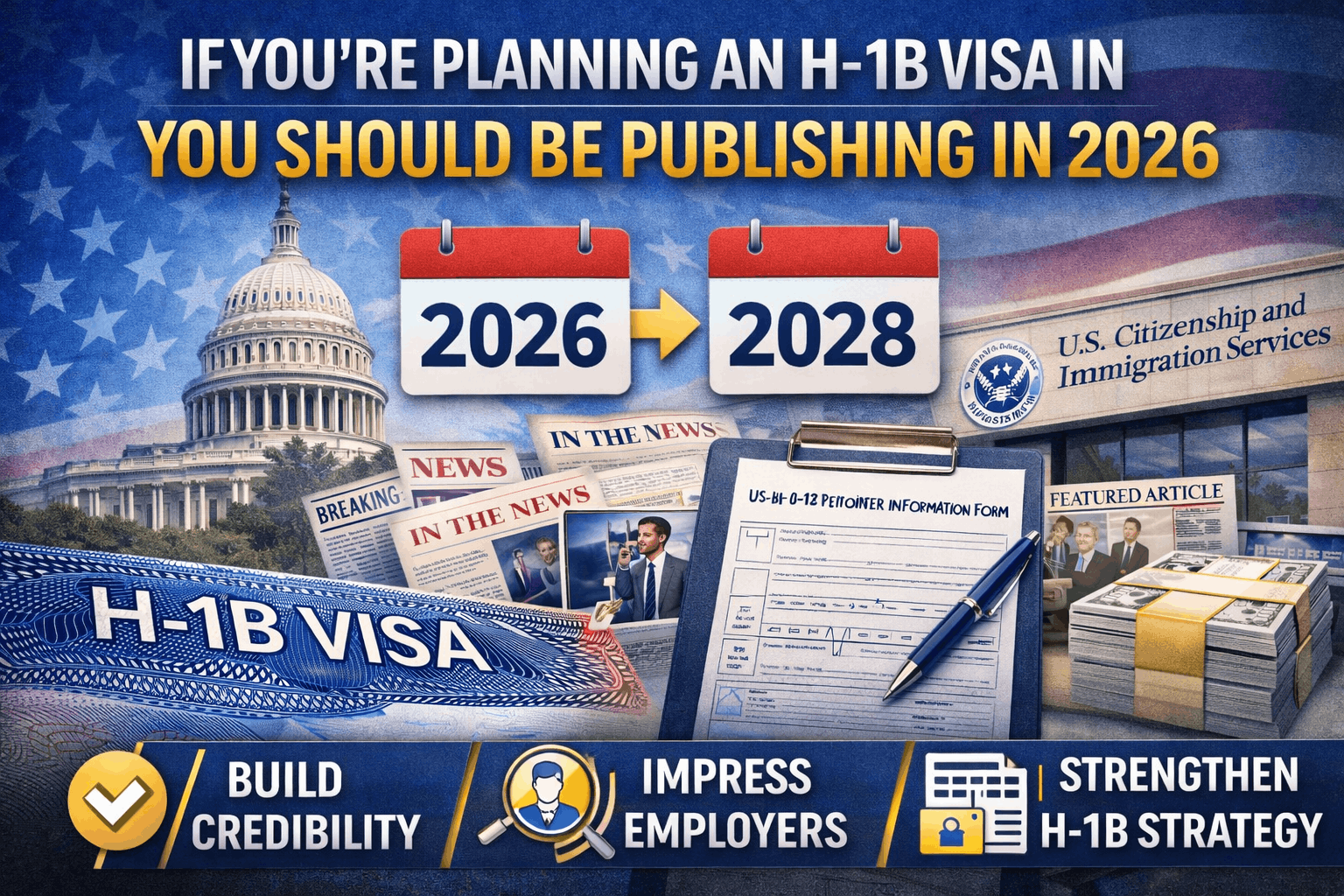
Most professionals think of the H-1B visa as a one-year event—a registration window, a lottery, a petition. That mindset is exactly why many strong candidates lose momentum, struggle to find sponsors, or realize too late that they look indistinguishable from thousands of others.
If you are seriously planning an H-1B visa in 2028, the smartest move you can make is not in 2028. It’s in 2026—by intentionally building media and professional visibility long before the registration year.
This article explains why early publishing matters, how it affects employer sponsorship and selection outcomes, and what kind of visibility actually helps—without hype, shortcuts, or last-minute tactics.
The H-1B Reality Most Applicants Miss
The H-1B visa is technically employer-driven. That fact often leads candidates to believe their role is passive: get hired, let the employer file, hope for selection. In practice, employers make risk-based decisions long before any registration happens.
By the time H-1B registration opens, employers are already asking themselves:
-
Is this candidate worth sponsoring?
-
Will they still be here after approval?
-
Does this person add long-term value?
-
Are they credible beyond their resume?
Those questions are not answered in March 2028. They are answered by everything the employer sees about you in the two years before that.
Why 2026 Matters for a 2028 H-1B Plan
Think of H-1B preparation as a timeline, not a date.
-
2028 is the filing year.
-
2027 is when employers finalize sponsorship decisions.
-
2026 is when your professional narrative is being formed.
Publishing in 2026 gives your visibility time to age, mature, and look organic. Content that exists for years signals consistency, not desperation. It shows you were building a professional reputation before immigration intent became urgent.
From an employer’s perspective, that difference is enormous.
Media Visibility Is Not About Immigration—It’s About Trust
One common misconception is that media publishing is only relevant for “extraordinary ability” visas. In reality, media visibility works differently for H-1B—and that’s why it’s so powerful.
For H-1B, media visibility doesn’t prove eligibility. It proves credibility.
Employers are more confident sponsoring candidates who:
-
Are recognized publicly in their field
-
Have opinions or insights others cite
-
Appear knowledgeable beyond internal company work
-
Demonstrate career seriousness
Media articles, interviews, and expert commentary quietly answer the question: “Is this person real, reliable, and here for the long term?”
The Employer Risk Equation (And Where You Fit)
Sponsoring an H-1B candidate is expensive, time-consuming, and uncertain. Employers bear:
-
Legal fees
-
Compliance obligations
-
Operational disruption
-
Lottery risk
When an employer compares two equally skilled candidates, the one with visible professional authority often feels safer.
Publishing early helps tilt that equation in your favor by signaling:
-
Stability
-
Commitment to the field
-
Professional maturity
-
Lower attrition risk
None of that can be rushed in the filing year.
Why “Last-Minute Publishing” Backfires
Many applicants discover media publishing in the year they want sponsorship. The result is predictable:
-
Clustered articles
-
Promotional tone
-
Low-authority outlets
-
Content with no history
To an employer—or later, to USCIS—this looks reactive. Even if no one explicitly calls it out, it feels manufactured.
Publishing in 2026 for a 2028 plan avoids that entirely. Your content has:
-
Time stamps
-
Natural gaps
-
Topic evolution
-
Independent credibility
It doesn’t look like it was done for a visa. It looks like it was done because you belong in the field.
What “Publishing” Actually Means (And What It Doesn’t)
Publishing does not mean flooding the internet with self-written PR.
Effective early visibility usually includes:
-
Industry commentary
-
Thought-leadership articles
-
Expert quotes in reputable outlets
-
Practical insights tied to your work
-
Clear association with your professional niche
What doesn’t help:
-
Personal blogs with no readership
-
Promotional press releases
-
Anonymous content farms
-
One-off articles right before filing
The goal is recognition, not noise.
How Early Publishing Helps You Even Before Sponsorship
Here’s the part many applicants overlook: publishing early helps you before H-1B even enters the conversation.
Candidates with visible professional footprints often experience:
-
Better job interviews
-
Faster trust with hiring managers
-
Stronger internal advocacy
-
More leadership interest
-
Easier sponsorship conversations
When a manager already sees you as an industry voice, sponsorship becomes a continuation—not a leap.
The Compounding Effect of Time
Time multiplies the value of media.
An article published in 2026:
-
Can be referenced in 2027 conversations
-
Can be cited by others
-
Can support multiple job transitions
-
Can still exist during extensions or transfers
Publishing early creates assets, not tactics. Each piece adds to a growing narrative that you don’t have to explain every time—you just point to it.
Why USCIS Outcomes Still Benefit Indirectly
Although H-1B is employer-filed, petitions are still reviewed by USCIS officers who assess:
-
Role legitimacy
-
Specialty occupation alignment
-
Employer need
-
Candidate credibility
A candidate with public professional recognition:
-
Looks more aligned with specialized roles
-
Feels less generic
-
Strengthens the overall petition narrative
It doesn’t replace legal requirements—but it reinforces them.
The Psychological Advantage You Gain
Early publishing changes how you show up.
Candidates who publish years in advance:
-
Speak with more confidence
-
Advocate for themselves better
-
Articulate value clearly
-
Negotiate from strength
That confidence is visible in interviews, performance reviews, and sponsorship discussions. It’s hard to quantify—but impossible to fake.
Why “I’ll Do It After I Get the Visa” Is the Wrong Order
Many professionals think visibility should come after immigration success. In reality, visibility is often what enables that success.
H-1B favors candidates who:
-
Look settled
-
Look invested
-
Look valuable beyond one role
Publishing after approval doesn’t help with:
-
Employer selection
-
Sponsorship decisions
-
Transfer opportunities
-
Extensions or future visas
Publishing before does.
What a Smart 2026–2028 Timeline Looks Like
2026
-
Begin publishing thoughtfully
-
Establish core topics
-
Build credibility gradually
2027
-
Deepen authority
-
Maintain consistency
-
Let content age naturally
2028
-
Apply with a visible professional history
-
Discuss sponsorship from a position of strength
-
Look prepared, not rushed
This timeline reduces stress and increases options.
Why This Strategy Is Especially Important Now
H-1B policies are tightening. Costs are rising. Employers are cautious. Competition is global.
In this environment, candidates who look interchangeable struggle. Candidates who look established stand out.
Media visibility is one of the few levers fully under your control—and it rewards those who act early.
The Role of Strategic Media Partners
Executing this well often requires guidance—especially to avoid low-quality or irrelevant exposure. Platforms like Brandhexa focus on long-term, credibility-driven publishing rather than short-term publicity.
The emphasis is not volume, but positioning—helping professionals appear where it actually matters, early enough for it to count.
A Simple Question to Ask Yourself
If an employer Googled your name today, would they see:
-
A professional narrative?
-
Evidence of thought leadership?
-
Signs of long-term commitment?
If the answer is “not yet,” that’s not a failure—it’s a timing opportunity.
Final Thought: H-1B Success Is Built Before It’s Filed
If you plan to apply for an H-1B visa in 2028, your preparation doesn’t start with paperwork. It starts with who you appear to be in 2026.
Publishing early:
-
Reduces risk
-
Builds trust
-
Creates leverage
-
Expands options
In the H-1B journey, time is not something to wait out. It’s something to use strategically.
If you’re serious about 2028, the best year to act is now.
Frequently Asked Questions (FAQs)
What does “publishing early” mean for H-1B applicants?
Publishing early means building professional and media visibility—such as industry articles, expert commentary, or thought-leadership content—2–4 years before you plan to apply for an H-1B visa, not during the filing year.
Is media publishing required for an H-1B visa?
No, media publishing is not a formal requirement. However, early professional visibility helps employers evaluate credibility and long-term value, which strongly influences sponsorship decisions.
Why should someone planning an H-1B in 2028 start publishing in 2026?
Starting in 2026 allows your visibility to age naturally, making it appear organic rather than rushed. Employers are more likely to trust candidates who show long-term commitment and professional consistency.
How does media visibility help with H-1B sponsorship?
Media visibility helps employers see you as:
-
Established in your field
-
Serious about your career
-
Less risky to sponsor
This makes sponsorship conversations easier, especially when costs and scrutiny are increasing.
Does media visibility affect the H-1B lottery?
Media visibility does not influence the lottery selection itself. However, it can affect whether an employer chooses to sponsor you at all, which is the step that comes before the lottery.
What type of media content is useful for H-1B applicants?
Useful content includes:
-
Industry insights
-
Technical or professional explainers
-
Expert opinions
-
Articles related to your role or domain
Purely promotional or unrelated content has little value.
Is last-minute media publishing effective for H-1B?
Last-minute publishing usually has limited impact. Content created only in the filing year may appear reactive and does not build the same level of trust as visibility developed over several years.
Does early publishing help beyond the first H-1B filing?
Yes. Early professional visibility can support:
-
H-1B transfers
-
Employer changes
-
Extensions
-
Long-term U.S. career growth
It remains valuable well beyond the initial petition.
Can international applicants publish media before moving to the U.S.?
Yes. Media published outside the U.S. is still valuable as long as it is professionally relevant, credible, and consistent with your field.
How does professional visibility relate to USCIS review?
While the H-1B visa is employer-sponsored, petitions are reviewed by USCIS. A well-documented, credible candidate profile can strengthen the overall petition narrative.
Is publishing early useful even if H-1B plans change?
Yes. Professional visibility improves career opportunities, employer trust, and global credibility, regardless of visa outcomes. It is a long-term career asset, not a one-time visa tactic.
Comments are closed