
TL;DR — Quick Comparison
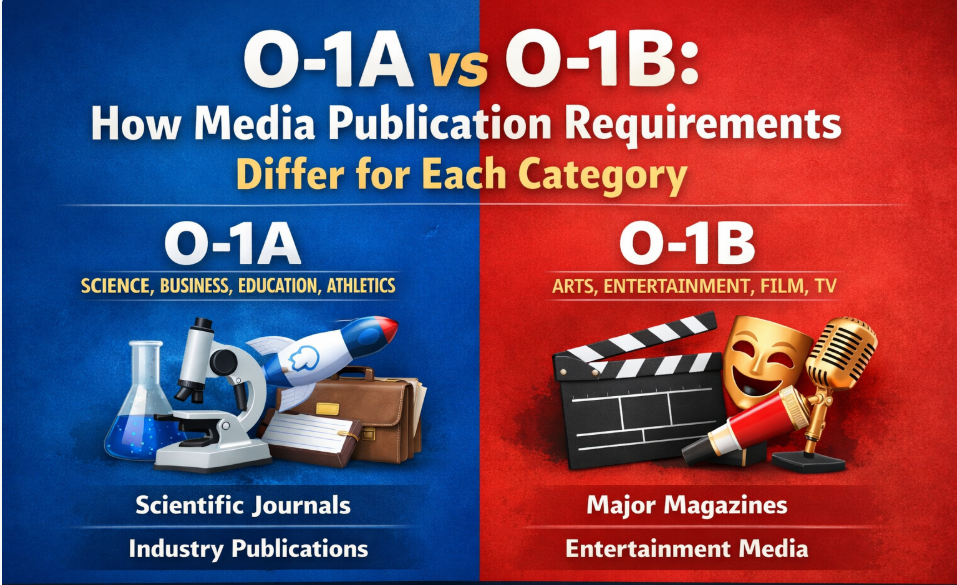
O-1A: Press must be in major trade or professional media, specifically about the applicant as an individual.
O-1B Arts: Broader standard — critical reviews, promotional materials, and trade publications all qualify. Coverage can be “by or about” the beneficiary.
O-1B MPTV: Most unique — box office receipts, ratings, and trade coverage of productions you worked on are explicitly accepted evidence.
Knowing which standard applies to your category before building your petition is essential to avoiding an RFE.
If you have researched the O-1 visa, you have likely encountered one consistent message: media coverage matters. But what most guides fail to explain is that the media evidence standard is not the same across all O-1 categories.
The O-1 visa has three distinct sub-categories — O-1A, O-1B Arts, and O-1B MPTV — and each evaluates published material through a different lens. Submitting the wrong type of coverage, or failing to understand what qualifies for your specific category, is one of the most common reasons USCIS issues a Request for Evidence.
This guide breaks down exactly how the O-1A vs O-1B media publication requirements differ, what outlets qualify for each sub-category, and the strategic implications for building your petition.
Understanding the Three O-1 Sub-Categories
Before comparing media standards, it is important to understand what each sub-category covers — because the legal standard for your media evidence flows directly from your category’s definition.
O-1A — Extraordinary Ability in Science, Business, Education, or Athletics
O-1A covers professionals in science, technology, engineering, mathematics, education, business, and athletics. To qualify, you must demonstrate sustained national or international acclaim and prove you are among the small percentage who have risen to the very top of your field.
O-1B Arts — Extraordinary Ability in the Arts
O-1B Arts covers performers, musicians, visual artists, fashion designers, writers, and other creative professionals. The legal standard is reaching a level of distinction — defined as prominence or renown in your artistic field. This is a slightly lower threshold than O-1A’s ‘very top’ requirement, but it comes with its own evidentiary complexity.
O-1B MPTV — Extraordinary Achievement in Motion Picture or Television
O-1B MPTV is for film directors, producers, actors, cinematographers, and other industry professionals whose work is centered on the motion picture or television industry. This sub-category requires demonstrating a record of extraordinary achievement — a distinctly different standard that introduces commercial performance data into the evidence mix.
The Core Difference — “Extraordinary Ability” vs “Extraordinary Achievement”
This is the legal distinction that underpins everything. O-1A and O-1B Arts both use the phrase “extraordinary ability.” O-1B MPTV uses “extraordinary achievement” — and that single word difference changes how USCIS evaluates your entire petition, including your media evidence.
Why This Legal Distinction Changes Your Entire Media Strategy
For O-1A and O-1B Arts applicants, media coverage must demonstrate that you are recognized as a person of outstanding individual ability in your field. The press must be about you — your work, your expertise, your recognition by peers.
For O-1B MPTV applicants, media evidence can include coverage of the productions you worked on — box office results, ratings, critical reception — where your specific contribution to that commercially successful work is documented. The focus can be on the project’s achievement where your role is clearly established, not just personal profiles.
O-1A Media Publications — What the Criterion Requires
For O-1A petitions, the published material criterion (Criterion 3 of 8) requires published material in professional or major trade publications or major media, about the beneficiary, relating to the beneficiary’s work in the field for which classification is sought.
What Counts as “Major Media” for O-1A?
For O-1A applicants — particularly those in tech, science, or business — qualifying media typically includes:
- National and international newspapers and news websites (New York Times, CNN, BBC, Reuters)
- Major industry trade publications (TechCrunch, Wired, MIT Technology Review, VentureBeat, STAT News)
- Peer-reviewed journals where the article is about you — not authored by you (authorship is a separate criterion)
- Podcasts and broadcast segments with attached transcripts, from programs with documented reach in your field
- Digital-first publications, explicitly confirmed as qualifying by the January 2025 USCIS policy update
The critical rule for O-1A remains consistent: coverage must be primarily about you as an individual, not your company, team, or institution.
The Comparable Evidence Provision — O-1A’s Unique Flexibility
One important advantage exclusive to O-1A applicants is the comparable evidence provision. If a petitioner can demonstrate that a particular criterion does not readily apply to the beneficiary’s occupation, they may substitute evidence of comparable significance.
In practice, this means an entrepreneur or niche-field researcher who has not received mainstream press coverage might substitute a major conference keynote, a highly cited white paper, or significant speaking engagements — provided the petitioner makes a clear written argument for comparability. O-1B applicants do not have this same flexibility built into the media criterion.
O-1A Strategy Note
If you are in a highly technical or niche field where mainstream press is rare, document the comparable evidence provision in your petition cover letter. Clearly explain why traditional media is not readily applicable to your occupation and what alternative evidence you are substituting — and why it demonstrates equivalent recognition in your field.
O-1B Arts Media Publications — A Broader and More Flexible Standard
The media criterion for O-1B Arts is structurally similar to O-1A but opens the door to a wider range of evidence types. USCIS evaluates published material in professional or major trade publications or major media about the beneficiary — but it also explicitly accepts critical reviews and promotional materials as qualifying evidence.
Critical Reviews, Promotional Materials, and Trade Publications
For O-1B Arts applicants, the following types of published material are routinely accepted and carry significant weight:
- Critical reviews from established arts critics in major newspapers, magazines, or arts publications — a dance review in the New York Times, a music review in Rolling Stone
- Trade publications specific to your art form — Variety, Billboard, Artforum, The Art Newspaper, Publishers Weekly
- Promotional materials — theater programs, gallery catalogs, concert bills — that document your role in major productions or exhibitions
- Festival programs and awards documentation from major international arts festivals
- International media coverage within your artistic community, with certified English translations attached
What “By or About” Means for Arts Applicants
USCIS case law has established that for O-1B Arts, coverage must be “by or about” the beneficiary. This is subtly broader than O-1A’s “about the beneficiary” standard. A music review written by the beneficiary and published in a major outlet can satisfy the criterion — whereas for O-1A, authored material falls under the separate scholarly articles criterion, not the media coverage criterion.
O-1B MPTV — The Most Distinct Media Evidence Standard
O-1B MPTV has the most different media evidence framework of the three sub-categories. While some criteria overlap with O-1B Arts, USCIS explicitly allows commercial performance data to function as media evidence for MPTV petitions.
Box Office Receipts, Ratings, and Commercial Success as Media Evidence
For O-1B MPTV applicants, USCIS accepts the following under the published material and related criteria:
- Box office receipts demonstrating commercial success of productions you worked on
- Ratings data — Nielsen ratings, streaming figures — for television productions
- Critical acclaim — review aggregations like Rotten Tomatoes scores used as supporting context
- Award nominations and wins — Emmy, Oscar, Golden Globe nominations function as media recognition evidence
- Trade coverage in Variety, The Hollywood Reporter, Deadline Hollywood — covering the production and your credited role
- Publicity releases and studio-issued press materials documenting your credited position
Why MPTV Has a Higher Subjectivity Bar
USCIS has explicitly noted that O-1B MPTV criteria tend to be more subjective than O-1A criteria. This is by design — the motion picture and television industry measures success through commercial performance, industry recognition, and critical reception rather than objective professional metrics. The tradeoff is that while the evidence types are broader, USCIS officers have more discretion in how they weigh that evidence.
MPTV Warning
Do not rely solely on trade coverage of a production to satisfy your media criterion. USCIS requires that your specific role and contribution be clearly documented within or alongside the publication. A Variety article about a blockbuster film does not automatically establish your extraordinary achievement unless your credited role is clearly tied to that article.
Side-by-Side Comparison Table
| O-1A | O-1B Arts | O-1B MPTV | |
| Legal Standard | Extraordinary ability — “very top” of field | Extraordinary ability — distinction / prominence | Extraordinary achievement — record of outstanding work |
| Media Criterion | Criterion 3 of 8 — need 3 of 8 total | One of 6 criteria — need 3 of 6 total | One of 6 criteria — need 3 of 6 total |
| Qualifying Outlets | Major media, professional trade publications, digital-first outlets | Trade publications, critical reviews, promotional materials, arts media | Trade coverage, box office receipts, ratings, publicity releases |
| Coverage Must Be | About the beneficiary specifically | By or about the beneficiary | About productions with documented role of beneficiary |
| Commercial Data OK? | No — recognition-based only | Rarely — artistic acclaim focused | Yes — box office and ratings explicitly accepted |
| Comparable Evidence? | Yes — formal provision available | Limited — less flexible | Limited — less flexible |
| Typical Press | Forbes, TechCrunch, NYT, MIT Tech Review | Rolling Stone, Artforum, NYT Arts, Variety | Variety, Hollywood Reporter, Deadline |
Common Mistakes Specific to Each Category
O-1A Mistakes
- Submitting articles about your company or research team without demonstrating your specific individual contribution
- Confusing authored scholarly articles (Criterion 6) with published media about you (Criterion 3) — they are separate criteria
- Failing to invoke the comparable evidence provision when mainstream press is scarce in your niche field
O-1B Arts Mistakes
- Including reviews or festival mentions where you are only listed as a participant — USCIS has denied petitions where coverage “only lists the beneficiary as a participant without discussing their work”
- Submitting support letters that quote reviews instead of attaching the actual review articles themselves
- Relying on social media following or audience metrics as a substitute for editorial press coverage
O-1B MPTV Mistakes
- Submitting trade coverage of a production without clearly documenting the applicant’s specific credited role in that production
- Using box office data alone without tying it explicitly to the applicant’s contribution to that commercial success
- Confusing the ‘lead or critical role’ criterion with the ‘published material’ criterion and double-counting the same evidence
Which Category Has the Harder Media Standard?
This is a common question — and the honest answer is: it depends on your specific career profile.
O-1A is often considered harder overall because the ‘very top of the field’ standard is more exacting — but for media specifically, the comparable evidence provision gives O-1A applicants a useful flexibility when mainstream press is thin.
O-1B Arts has a broader evidence toolkit, but the ‘by or about’ standard and the need for genuine editorial independence means low-quality reviews or passing mentions will not carry weight.
O-1B MPTV is unique in allowing commercial performance data, but the subjectivity of adjudication means the same petition can receive different outcomes depending on the officer. Strong documentary evidence tying the applicant’s role to the production’s recognized success is essential.
Frequently Asked Questions
Q: Does O-1B require more media coverage than O-1A?
Not necessarily more, but different. O-1B Arts accepts a wider range of evidence types including critical reviews and promotional materials that O-1A does not. O-1B MPTV adds commercial performance data. The quantity expectation — typically 3 to 5 strong pieces — is similar across all categories, but the type of evidence that qualifies varies significantly.
Q: Can critical reviews count as media publications for O-1B?
Yes, for O-1B Arts and O-1B MPTV. Critical reviews in established outlets — a theater review in the New York Times, a film review in Variety — are explicitly recognized as qualifying evidence. The review must discuss the beneficiary’s work substantively, not merely mention their name in passing.
Q: What media publications qualify for O-1B arts visa?
Major arts trade publications (Billboard, Rolling Stone, Artforum, Variety, The Art Newspaper), mainstream media with arts coverage (New York Times, The Guardian), and credible digital publications covering the applicant’s specific artistic field all qualify. The outlet must have established editorial credibility and the coverage must substantively discuss the beneficiary’s work.
Q: Can the same media article satisfy both O-1A and O-1B criteria?
An applicant can only file under one O-1 sub-category at a time, so the same article would not need to satisfy both. However, if a professional later files under a different category, previously documented media coverage can support the new petition if it remains relevant to the field of claimed extraordinary ability.
Q: O-1B MPTV — do box office receipts count as media evidence?
Yes. USCIS explicitly accepts box office receipts as evidence under O-1B MPTV criteria. However, receipts alone are not sufficient — they must be paired with documentation of the applicant’s specific credited role in the production and evidence that the commercial success is recognized within the industry.
Conclusion
The O-1 visa is not a single standard — it is three distinct evidentiary frameworks, each with its own approach to what media coverage qualifies and how it must be presented.
O-1A requires press about you in major professional media, with a comparable evidence safety valve for niche fields. O-1B Arts broadens that to include critical reviews and trade publications under a ‘by or about’ standard. O-1B MPTV introduces commercial performance data as a unique evidence type unavailable in the other categories.
Understanding which standard applies to your category before you build your petition is the difference between a clean approval and a costly RFE. Match your evidence to your category, document every outlet’s credibility, and never assume USCIS will make the connection for you.
Disclaimer: This article is for informational purposes only and does not constitute legal advice. Consult a licensed immigration attorney for guidance specific to your O-1 visa situation.
Comments are closed