
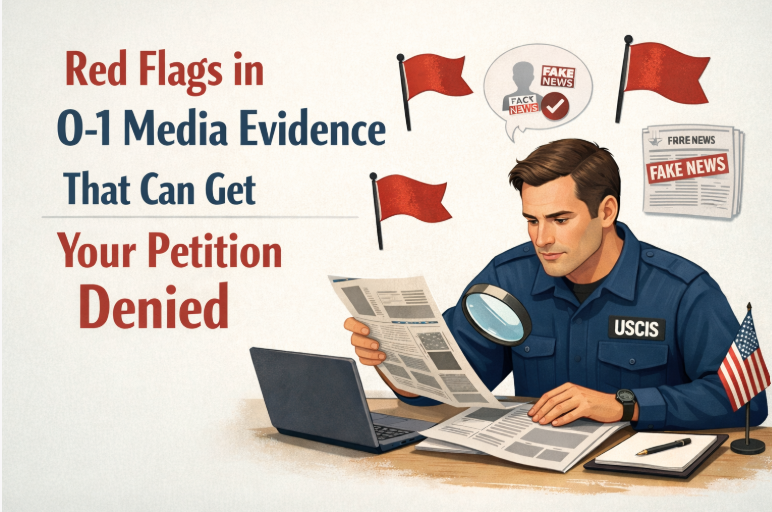
You have press coverage. You have headlines. You have a stack of articles with your name in them. And yet, a USCIS officer reads through your petition and issues a Request for Evidence, or worse, a denial.
This is not a rare situation. It happens to a significant number of O-1 petitioners every year, and a large portion of those cases fail not because of a lack of real achievement, but because the media evidence submitted contains problems that undermine the entire petition.
USCIS officers who review O-1 applications are trained to evaluate media evidence critically. They are not impressed by volume. They are not swayed by brand name recognition of a publication alone. They are looking for specific signals that distinguish genuine editorial coverage from manufactured press. When they find the opposite, it damages your credibility across the entire petition.
This guide breaks down every major red flag that gets O-1 media evidence dismissed or denied, why each one triggers concern, and what you need to do instead to build a media record that actually survives scrutiny.
Why Media Evidence Is So Heavily Scrutinized in O-1 Petitions
Under 8 C.F.R. § 214.2(o), an O-1 applicant must meet at least three of eight evidentiary criteria to qualify. Published material in professional or major trade publications or other major media is one of those criteria. The regulation requires that the coverage be about the beneficiary and relate directly to their work in the field for which the visa is sought.
This criterion exists because independent third-party recognition is treated as one of the strongest signals of extraordinary ability. If journalists and editors at credible publications have chosen to write about you and your contributions, that tells USCIS something meaningful. It suggests that your peers and the broader professional community view your work as significant enough to report on.
The problem is that the media landscape has made it increasingly easy to obtain the appearance of press coverage without earning it through merit. Articles that appear advertorial, media placements obtained through sponsorships or paid PR services, and content published on platforms controlled by the beneficiary or their employer are common red flags that can trigger an RFE. USCIS officers know this, and they have become substantially more rigorous in evaluating what media evidence genuinely represents.
The stakes are real. Published material RFEs increased when articles lack substantive discussion of the founder’s work, and officers want clear evidence separating personal achievements from team accomplishments or company milestones.
Red Flag 1: Paid Placements and Sponsored Content
This is the single most common and most damaging red flag in O-1 media evidence packages. Paid placement refers to any situation where money changed hands in exchange for the coverage, whether it was labeled “sponsored,” “advertorial,” “brand content,” or simply arranged through a PR firm that paid for placement.
USCIS has become increasingly skilled at identifying paid media. Officers look at how the article is framed, whether it contains a disclosure label, how the outlet typically handles branded content, and whether the language reads like editorial writing or promotional copy. When an article sounds like it was written by a marketing team rather than a journalist, it raises immediate red flags regardless of which outlet published it.
The issue goes beyond just the label. Even articles that do not carry a sponsored disclosure can be flagged if they appear on sites that are known to publish paid content without clear distinction from organic editorial, or if the article’s tone and structure closely resembles promotional material. Flattery without factual depth, superlatives without attribution, and claims without verifiable context are all signs that an article was written to sell rather than to inform.
The practical consequence is significant. A paid placement that might have cost thousands of dollars to arrange can be dismissed by an officer in thirty seconds. Worse, submitting paid content as evidence of independent recognition can cast doubt on the rest of your media submissions. If one article appears manufactured, an officer may look more skeptically at everything else in the package.
What you need instead is editorial coverage earned through outreach, relevance, and newsworthiness. An article that a journalist chose to write about you, based on the merit and significance of your work, without any payment or arrangement is the standard that USCIS expects.
Red Flag 2: Coverage About Your Company, Not About You
This is the red flag that catches the most founders, executives, and entrepreneurs by surprise. An article about your company raising a funding round, launching a product, or reaching a revenue milestone is not the same as an article about your individual contributions to your field.
Officers reject articles focusing on the company rather than the founder personally, and USCIS demands clear individual attribution throughout all evidence. The published material criterion is specifically about the beneficiary as an individual. Even if you are the CEO or founder, coverage of your organization’s achievements does not fulfill this requirement unless the article meaningfully connects those achievements to your personal expertise, vision, leadership, or innovation.
The practical test is simple: if you removed your name from the article and replaced it with your company name, would the article say essentially the same thing? If yes, the coverage is about the business, not about you.
What qualifies is coverage where you are centered as the subject. The journalist discusses your background, your specific contributions, your methodology, or your impact on your field. Your company may be mentioned as context, but the article’s focus is your individual professional standing.
This distinction also extends to team-based achievements. Did you personally create the innovation or did your engineering team? Does press coverage highlight your expertise or just company growth? Officers are specifically trained to probe whether the individual or the collective is being recognized.
Red Flag 3: Low-Traffic or Unverifiable Publications
Not every website that publishes content qualifies as major media or a recognized professional publication. USCIS officers are aware that there are thousands of websites that present themselves as news outlets but have no meaningful audience, no editorial infrastructure, and no reputation within any professional community.
When an officer encounters an outlet they do not recognize, they look for evidence of its standing. This may include circulation or traffic data, the presence of an identifiable editorial staff, industry recognition or awards, or simply whether the publication is referenced or respected within the relevant field.
If a publication has no verifiable traffic, no editorial board listed, no known writers or editors, and does not appear in any industry conversation, the coverage it published is unlikely to carry weight regardless of how well the article itself is written. Submitting ten articles from ten different obscure websites is not a substitute for one article in a genuinely respected publication.
This is particularly relevant for online-only outlets. USCIS must consider industry-specific or major online publications as eligible to meet the criterion, but the platform must have real credibility and audience reach. A digital publication with substantial traffic, an established editorial team, and a genuine reputation within its professional niche can absolutely qualify. A website that appears to exist primarily as a vehicle for paid content distribution cannot.
Red Flag 4: Press Releases and Wire Distribution Treated as Editorial Coverage
Press releases distributed through wire services like PR Newswire, Business Wire, or EIN Presswire are not published material in the editorial sense. They are self-authored promotional announcements paid for by the company or individual issuing them. Even when they are picked up and reprinted verbatim on third-party websites, they remain press releases.
USCIS officers know the difference between an article and a press release. A press release typically uses company-approved language, avoids critical analysis, contains a standardized boilerplate, and lacks the independent perspective of a journalist. When these characteristics appear in submitted evidence, the material is dismissed.
The confusion often arises because press releases can appear on highly authoritative news distribution sites or be indexed alongside legitimate news on Google. The platform does not determine whether the content is editorial. The origin and production method do.
Wire-distributed content also has another problem. The same release appears word for word across dozens or hundreds of websites. Submitting multiple versions of the same press release as separate pieces of evidence is a transparent attempt to inflate the volume of media coverage, and it draws negative attention from officers who will simply count it as one instance, or dismiss it entirely.
Red Flag 5: Articles That Are Mentions, Not Features
There is a meaningful difference between being mentioned in an article and being the subject of an article. USCIS requires coverage that is about the beneficiary. A passing reference in a roundup, a brief quote among many experts, or a name listed among contributors to a project does not satisfy that standard.
The question an officer asks is whether the article would be substantially different without the petitioner. A true feature dedicates significant attention to explaining who you are, what you have done, and why it matters. A mention simply acknowledges your existence in passing.
Common examples of mentions that petitioners mistakenly include as published material evidence include industry listicles where fifty professionals are named, news articles where you are quoted once as a general industry voice, team-based features where your company’s staff is collectively profiled, and event coverage where you are listed as a speaker without substantive analysis of your work or expertise.
Quality over quantity: three strong, distinct pieces of evidence for a criterion are better than fifteen weak, repetitive ones. A single editorial feature that examines your specific contributions and positions you as a recognized authority is worth far more than a dozen mentions that collectively fail to establish your individual standing.
Red Flag 6: Guest Posts and Self-Authored Content
If you wrote the article, it cannot serve as evidence under the published material criterion. Full stop. USCIS is explicit that this criterion requires material written about the beneficiary, not by the beneficiary.
Guest posts, contributor articles, bylined expert columns, and opinion pieces are all authored by you. Even when published on a major platform, they represent your own perspective on your work rather than an independent journalist’s assessment of your significance. Self-authored content belongs under the “authorship of scholarly articles” criterion if it meets that standard, not under published material.
This is a frequent mistake, particularly among subject matter experts who have built a content marketing presence. Being published as a contributor on Forbes, Entrepreneur, or similar platforms feels significant. It is not the same as being featured by a Forbes journalist in an independently reported article. One is outreach you initiated and content you produced. The other is recognition someone else chose to bestow.
Petitioners sometimes attempt to blend the two by submitting a combination of bylined contributions and independent coverage from the same outlet. Officers will sort through this combination and will only count the independently written articles.
Red Flag 7: Syndicated or Duplicate Content Across Multiple Sites
A single article that appears across fifteen different websites does not represent fifteen pieces of media coverage. It represents one piece of content that was distributed or reprinted, either through a wire service, a content syndication arrangement, or through copying.
Officers recognize syndicated content by its identical or near-identical text appearing across multiple domains. When a petitioner submits what appears to be numerous articles but an officer identifies that they are all variations of the same source, it signals that the petitioner is trying to manufacture the appearance of broad coverage rather than having earned it through genuine editorial interest.
This red flag is particularly common when PR firms use content syndication as part of a press package strategy. The result looks impressive in a press kit but reads as a transparency problem in an immigration evidence package.
If coverage legitimately appears on multiple platforms because different outlets independently chose to report on the same story, that is a different situation. But it should be documented carefully, showing that each outlet made an independent editorial decision rather than simply reprinting the same release.
Red Flag 8: AI-Generated or Thin Content
With the widespread use of AI writing tools, USCIS officers have become alert to content that reads as machine-generated. Articles that sound too much like AI risk undermining credibility, and maintaining originality, reliable authorship, and editorial distance helps ensure that publications strengthen rather than weaken an O-1A visa application.
AI-generated coverage tends to be generic, lacks the specific detail that comes from a real journalist conducting research or interviews, and often reads with a uniformity of tone that differs from authentic editorial writing. When an officer encounters this quality of content, it raises questions about whether genuine editorial judgment was applied or whether a platform simply accepted auto-generated material for publication.
This is not just about content that was clearly machine-written. It also applies to thin articles that lack depth, specificity, or reporting. A 300-word piece that strings together vague praise without analyzing actual achievements tells an officer very little. Substantive coverage typically involves a journalist who researched your background, interviewed you or your peers, and produced an analysis that could not have been written without genuine reporting work.
Red Flag 9: Coverage That Misaligns With Your Field of Extraordinary Ability
An O-1 petition is filed in a specific field. Media evidence must relate to the work for which the classification is being sought. Coverage about your philanthropic activities, personal interests, lifestyle, or general business achievements in an unrelated sector does not satisfy the criterion, regardless of the quality of the outlet.
This misalignment is more common than it might seem. A technology entrepreneur who has been covered in general lifestyle press or business sections that focus on their personal wealth and spending rather than their technical contributions will find that coverage questioned. A scientist featured for their advocacy work rather than their research findings faces the same problem.
The relevance test is direct: does the article discuss the expertise, innovation, achievements, or impact that forms the basis of your extraordinary ability claim? If a reader would not understand from the article what specifically you have contributed to your field, the evidence is likely to be considered insufficient.
Red Flag 10: Presenting Quantity Over Quality
Submitting a large volume of media evidence in hopes that volume alone will satisfy the published material criterion is one of the most transparent strategies an officer encounters. A strong reputation within one organization, without broader recognition in the field, is insufficient, and self-promotion without corroboration from recognized experts leads to denials.
Officers are not counting articles. They are assessing the genuine signal value of the coverage as a whole. An evidence package with thirty articles from obscure outlets will score lower than one with four articles from respected trade publications, because the latter demonstrates that credible journalists and editors in your field have independently recognized your work.
This also applies to submitting the same weak evidence repeatedly in different forms. Recycled information dressed up in different articles, multiple mentions of the same award across different outlets, and coverage that all traces back to the same press release all reduce rather than increase the persuasive power of the package.
How These Red Flags Combine to Sink Petitions
Individual red flags are problematic on their own, but USCIS officers also look at patterns across a petition. When multiple red flags appear together, it signals a strategy of manufacturing the appearance of recognition rather than demonstrating genuine achievement.
A petition that contains paid placements, company-focused coverage, press releases dressed as articles, and low-traffic outlet features will receive a skeptical review not just of the media criterion but potentially of the overall credibility of the petition. Officers who identify a pattern of manufactured evidence tend to scrutinize every criterion more closely.
This is why media strategy for visa purposes needs to be built on authenticity from the beginning. The evidence package should tell a consistent, verifiable story of external recognition earned through the merit of your work.
What Genuinely Strong O-1 Media Evidence Looks Like
Strong media evidence for an O-1 petition has a recognizable character. The articles are written by identified journalists with bylines. The publications have verifiable audiences and editorial reputations within the relevant professional field. The coverage focuses on the individual petitioner and analyzes specific contributions, not just general prominence. Each article adds new perspective rather than repeating the same information.
Strong evidence also holds up to verification. Officers can and sometimes do verify publications, which is why authenticity is essential, and fabricated or misleading content can result in requests for evidence or denial.
To build this kind of media record, begin well before your petition filing date. Ideally, begin building media coverage six to twelve months before filing your O-1 petition, because genuine editorial relationships and independently earned features take time to develop.
For practical guidance on earning the right kind of press coverage, BrandHexa’s step-by-step resource on how to secure media publications for your O-1B visa covers the exact approach that holds up under USCIS scrutiny. If you want to understand the complete picture of what makes media evidence credible in the first place, our companion guide on what makes a media feature credible to a USCIS officer is the place to start.
Documenting Your Media Evidence Correctly to Avoid Procedural Problems
Even genuinely strong media evidence can create problems if it is documented poorly. Officers expect to see complete printed or PDF copies of articles, not links alone, because links can break or go behind paywalls. The publication name, publication date, article author, and outlet’s circulation or traffic standing should all be clearly identifiable from the materials submitted.
If a publication is not widely known, include supporting documentation of its standing. This can include traffic analytics screenshots, statements from the Audit Bureau of Circulations, descriptions of its editorial team and audience, or recognition the outlet itself has received within the professional community.
For non-English articles, certified translations are required. The translation must accompany the original-language source, and both should be included in the submission.
A well-organized cover letter or attorney exhibit letter explaining each piece of evidence is also important. Officers do not automatically connect the dots between a publication and its significance in your field. You need to explain, in plain language, why the outlet matters, what the article demonstrates about your standing, and how it relates to your extraordinary ability claim.
For detailed advice on presenting your evidence package effectively, our guide on how to get featured in news publications for your O-1 visa profile includes documentation strategies that immigration practitioners recommend.
The Bigger Picture: Media Evidence Within Your Whole Petition
O-1 media evidence does not exist in isolation. It works as one component of a larger narrative that should be consistent across all the criteria in your petition. When your recommendation letters describe you as a top expert in your field, your award evidence confirms external recognition of your achievements, and your media coverage shows that journalists have independently reported on your significance, those elements reinforce each other.
When any of them contain red flags, the doubt they generate spreads. A petition that scores highly on several other criteria but has weak or problematic media evidence will face harder scrutiny overall.
The goal is not to submit enough evidence to technically check a box. The goal is to tell a coherent, verifiable story about someone whose work has genuinely attracted independent recognition at the national or international level.
For professionals building their O-1 case over time, media coverage is one of the most controllable elements of that story. Unlike awards, which require nominations and selection processes, or critical roles, which depend on employment circumstances, media coverage can be actively pursued by connecting with journalists, positioning yourself as an expert source, and contributing meaningfully to industry conversations that attract editorial attention.
If you are preparing for an O-1 petition and need media coverage that genuinely meets USCIS standards, BrandHexa specializes in securing placements in high-authority publications including major Indian and international outlets that carry real weight with immigration adjudicators. You can also learn how media coverage directly strengthens visa applications in our resource on how media coverage can improve your visa application chances, and if you are building a long-term strategy, our piece on why O-1 visa applicants should build media authority years before applying is essential reading.
Disclaimer: This article is for informational purposes only and does not constitute legal advice. For guidance specific to your immigration matter, consult a licensed immigration attorney.
Comments are closed