
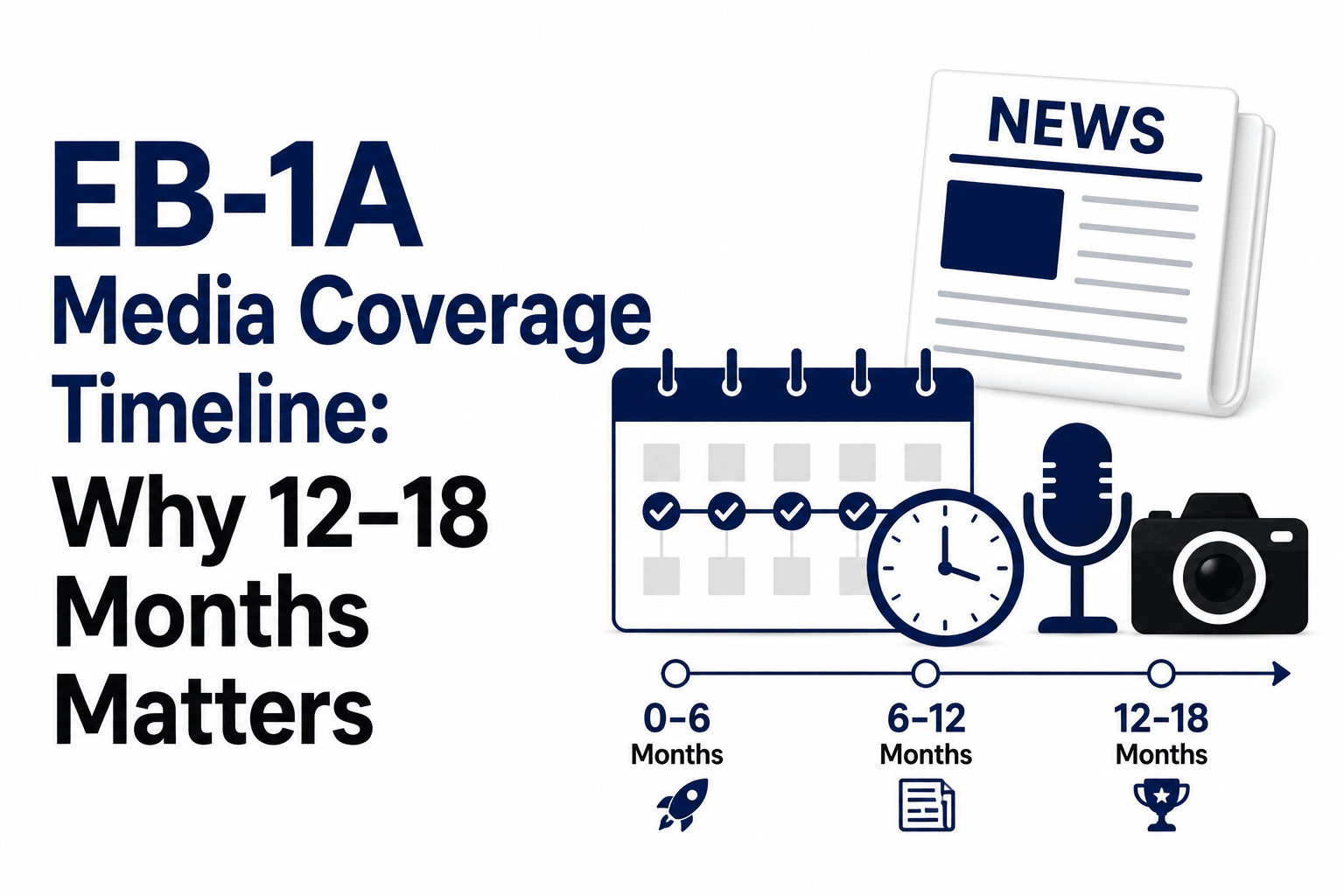
The 12 to 18 month figure that comes up so often in EB-1A planning is not an arbitrary rule of thumb. It reflects how USCIS actually reads a stack of articles at the final merits stage: coverage clustered in the weeks before filing looks like a petition built for USCIS, while coverage spread across a year and a half looks like recognition the petitioner already had, which happens to be documented. The regulation does not set a minimum age for any article, but the adjudicator’s read of the pattern changes substantially depending on how that pattern was built.
This matters more now than it did even two years ago. USCIS’s own Q1 FY2026 case processing data showed EB-1A approval rates falling to 47.5 percent, and regular processing without premium service currently runs 6 to 19 months depending on service center load. A petitioner who starts media outreach only after deciding to file is working against both a tighter adjudication standard and a filing process that leaves little room to add anything once the petition is submitted. Getting the runway right before filing is one of the few parts of this process a petitioner still fully controls.
Why the Clock Starts Before the Petition, Not During It
Once an I-140 is filed, the media record is locked. Coverage placed after filing does not strengthen the petition already under review, and RFE responses have their own tight windows that leave no time to build a longer pattern from scratch. This is why the 12 to 18 month period has to happen entirely before the petition goes in, not during the months USCIS spends adjudicating it.
The adjudicator’s task at the final merits stage is to judge whether the petitioner already had sustained acclaim, not whether they acquired some in preparation for filing. A profile with three articles dated within the same six-week span invites exactly that question. A profile with articles spaced across a year and a half, in outlets relevant to the petitioner’s field, reads as evidence of an existing reputation rather than a constructed one.
This distinction shows up most clearly when an attorney has to explain the record to an adjudicator during a response to a request for evidence. A petitioner whose coverage already spans eighteen months gives the attorney a straightforward narrative to work with. A petitioner whose entire record was placed in the two months before filing puts the attorney in the harder position of explaining away a pattern the officer has already noticed, rather than simply pointing to it as evidence.
The Four Phases That Make Up the Window
| Phase | Timing Before Filing | What Happens |
| Foundation | 18 to 13 months out | Identify field-relevant outlets, confirm editorial standards, secure the first placement |
| Building | 12 to 7 months out | Space two to three additional placements across different outlets and angles |
| Consolidation | 6 to 3 months out | Round out gaps in outlet type or field relevance identified during earlier placements |
| Documentation | 2 to 0 months out | Compile circulation data, certified translations, and final petition exhibits, without adding new outreach |
Petitioners who compress this into the final phase alone typically end up with coverage that reads as rushed, even when each individual article is genuinely strong, since the dates alone tell an adjudicator how the record was built.
What Happens When the Window Is Shorter Than Ideal
Not every petitioner has eighteen months of runway available. Career milestones, employer timelines, or a family circumstance sometimes force a filing date that leaves six months or less for media planning. In this situation, the priority shifts from spacing placements evenly to making each one count more individually: choosing outlets with the strongest, most well-documented editorial standing rather than the fastest turnaround, and leaning more heavily on other criteria such as original contributions or judging experience so published material carries less of the overall burden.
A compressed timeline is not disqualifying on its own. It does mean the petition’s cover letter and attorney strategy need to account for why the coverage looks the way it does, and it usually means the recommended article mix needs to be met with fewer, stronger placements rather than a wider but thinner spread.
Signs the Runway Has Already Started Too Late
A few warning signs suggest a petitioner is running out of the window they need. All existing coverage clusters within the last two or three months. Outreach has only just begun despite a filing date set for the near future. The petitioner has not yet identified which specific criteria, beyond published material, the petition will rely on. Any one of these on its own is manageable with the right adjustments, but two or more together usually mean the filing date itself, not just the media plan, needs a second look with the attorney handling the case.
Why EB-1A Needs a Longer Window Than O-1
Petitioners who have already gone through an O-1 filing sometimes assume the same six to twelve month runway applies here. It does not, and the difference comes from what each category is actually trying to prove. O-1 evidence only needs to support the specific engagement or role tied to the current petition, so a shorter, more recent body of coverage still functions as sufficient proof. EB-1A’s final merits stage is asking a broader question about a career-long pattern of acclaim, which is why the extra six months on the front end of the window matters specifically for this category and would be largely unnecessary for an O-1 filing covering the same petitioner.
Petitioners transitioning from O-1 to EB-1A, a common sequence, are often further along on this timeline than they realize, since coverage placed for the O-1 filing can typically be folded into the longer EB-1A record rather than treated as a separate project starting from zero. The practical effect is that a petitioner who planned their O-1 media strategy well may only need to add a year of additional coverage, rather than eighteen months of coverage built entirely from scratch, once EB-1A becomes the goal.
Tracking Progress Against the Timeline
A written timeline is only useful if someone is actually checking progress against it. Petitioners handling this without an attorney or media partner managing the calendar benefit from a simple quarterly check: how many placements exist so far, whether they span different outlets and dates or cluster together, and whether the remaining months before filing still allow time to fill any gaps identified. Waiting until the final quarter before filing to run this check for the first time usually means discovering a gap with no realistic time left to close it.
This is also the point at which a petitioner should confirm the filing date itself is still realistic. A timeline built around an eighteen-month runway that gets compressed to eight months partway through, because of a visa status deadline or a personal circumstance, needs to shift strategy immediately rather than simply working faster within the plan built for a longer window.
Mistakes That Undermine an Otherwise Good Timeline
Even petitioners who understand the twelve to eighteen month principle sometimes undercut it in practice. A few patterns show up repeatedly:
- Placing all articles through the same outlet because the relationship is already established, rather than diversifying to show recognition beyond one publication
- Treating the foundation phase as optional and starting outreach seriously only once the building phase is already underway, which quietly shortens the runway without the petitioner noticing
- Choosing outlets based on turnaround speed during the consolidation phase rather than field relevance, leaving the record with a burst of tangential coverage right before filing
- Assuming a long runway on its own guarantees a strong record, when spacing without genuine field relevance or outlet credibility does not fix an otherwise weak article
None of these mistakes are difficult to avoid once identified, but they are easy to fall into without someone actively tracking the plan against the calendar rather than just the calendar itself.
Building the Runway With Outside Support
BrandHexa’s EB-1A media publication service is structured around this phased approach specifically, since placing all requested coverage at once produces exactly the clustered pattern adjudicators discount. Petitioners who engage a media partner at the eighteen-month mark, rather than the six-month mark, generally have more outlet options available and more room to correct course if an early placement does not land the way the strategy intended. The outlets that carry the most weight for a given field are not always the fastest to respond, which is precisely why the earlier phases of the timeline exist.
Comments are closed