
Every year, thousands of EB-1 applicants submit press coverage they paid for and watch their petitions either come back with a Request for Evidence or get denied outright. The articles looked professional. The outlets were recognizable. The content mentioned their name and work. And none of it helped because they had purchased the placement.
This is one of the most expensive mistakes in the EB-1 petition process. Not expensive in terms of attorney fees or filing costs. Expensive in terms of wasted time, delayed priority dates, and in some cases, reputational damage to a petition that cannot be easily repaired.
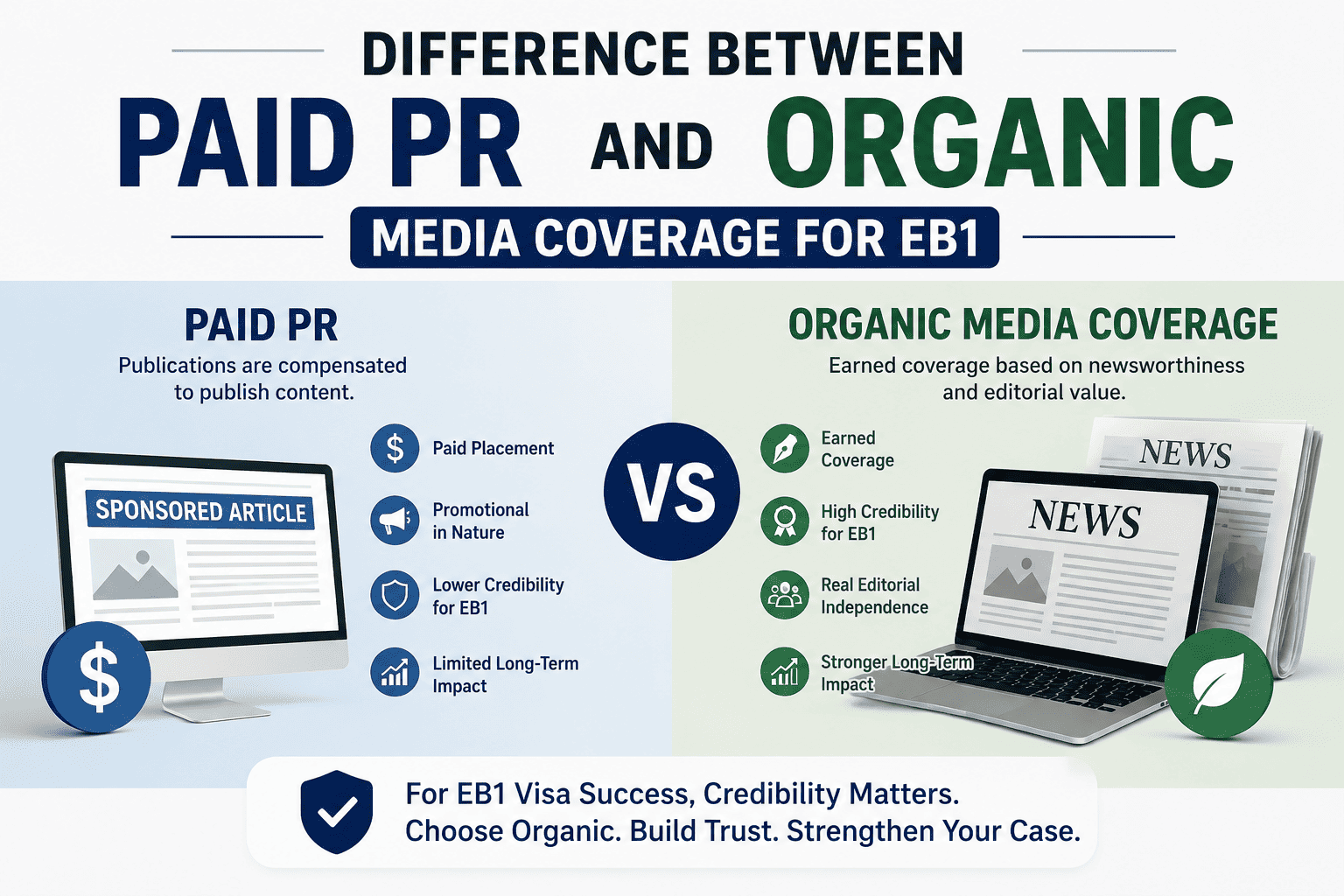
USCIS is not evaluating how much media coverage you have collected. It is evaluating whether that coverage represents independent recognition of your professional standing by journalists and editors who had no financial relationship with you. That is the standard. Paid PR fails that standard by definition. Organic editorial coverage satisfies it by design.
This guide explains exactly how those two categories differ, how USCIS adjudicators identify paid placements, what happens to petitions that include them, and what organic coverage actually looks like in practice.
What the EB-1 Published Material Criterion Actually Requires
What is the EB-1 Published Material Criterion?
The EB-1 published material criterion is one of ten evidentiary categories under 8 C.F.R. § 204.5(h)(3) that EB-1A applicants can use to demonstrate extraordinary ability. It requires evidence of published articles or media reports about the applicant and their work in professional or major trade publications or other major media. Each submitted piece must include the article title, date of publication, and author name. The article must focus on the applicant specifically and discuss their contributions substantively, not in passing.
The regulation’s wording is precise: the material must be “about” the applicant. Not about their employer. Not about a company milestone in which they participated. About the applicant as a professional whose individual expertise and contributions are the subject of the coverage.
USCIS applies a two-part test. First, adjudicators determine whether the article is genuinely about the applicant and their work. Second, they determine whether the outlet qualifies as a professional publication, major trade publication, or major media. Both tests must be cleared. Strong coverage in a weak outlet fails. An organic feature in a strong outlet that focuses on the company rather than the individual also fails.
Paid PR affects primarily the first test. When coverage is paid for, USCIS classifies it as self-promotional material, regardless of how editorially it appears on the surface. A paid article can look identical to an organic one in layout and tone, but the commercial relationship between the applicant and the publication disqualifies it as independent recognition.
Defining Paid PR in the Context of EB-1 Media Evidence
What is Paid PR?
Paid PR is any media coverage where the applicant, their employer, or a representative paid for placement, guaranteed publication, or exercised editorial control over the final content. This includes advertorials, sponsored features, press release distribution that results in verbatim republication, paid guest posts, and brand content studio placements. In each case, the publication of the article was contingent on a financial transaction rather than on the independent editorial judgment of a journalist.
Paid PR covers a wide spectrum of formats. At one end sits the obvious advertorial, marked with a “Sponsored Content” or “Paid Feature” disclaimer and visually separated from the publication’s editorial content. At the other end sits content that is harder to identify: articles with no visible disclaimer but where a PR firm paid the outlet directly for placement, or where the “interview” was scripted and submitted by the applicant’s team rather than researched by a journalist.
USCIS adjudicators have become significantly more capable at identifying both ends of this spectrum. Immigration officers handling EB-1 petitions in 2026 are trained to look for signals of paid placement even when no explicit disclaimer appears on the page. A petition that includes paid coverage does not just fail the media criterion. In documented cases, it has caused adjudicators to question the credibility of the entire petition, treating the presence of manufactured evidence as a signal that other evidence may also be inflated or misrepresented.
Defining Organic Media Coverage
What is Organic Media Coverage?
Organic media coverage is any article, interview, profile, or broadcast segment in which a journalist or editor independently decided to feature the applicant based on the newsworthiness or significance of their professional work. No payment changed hands for the placement. No script was submitted by the applicant’s team. The editorial judgment to cover the story belonged entirely to the publication.
Organic coverage arises from a specific set of circumstances. A researcher publishes findings that a science journalist decides to profile. A business executive leads a company through a documented turnaround that a financial publication chooses to examine. A healthcare specialist develops a clinical approach that produces verifiable patient outcomes and catches the attention of a health industry reporter. In each case, the coverage exists because the work itself warranted it, not because someone paid to create the appearance of recognition.
This distinction is precisely what the EB-1 published material criterion is designed to capture. USCIS wants to see that independent observers, specifically journalists and editors with no stake in the outcome, recognized the applicant’s work as significant. Organic coverage provides that evidence. Paid coverage does not, because the commercial relationship between the applicant and the outlet eliminates the independence that makes the recognition meaningful.
How USCIS Identifies Paid Coverage: 7 Signals Adjudicators Look For
Understanding how USCIS spots paid placements is essential before you assemble any media evidence. Each of the following signals can cause an adjudicator to flag an article as self-promotional and either disregard it or use it to raise credibility concerns about the broader petition.
1. Visible disclaimer language. The most direct signal is a line at the top or bottom of the article reading “Sponsored Content,” “Paid Feature,” “Promotional Content,” “Brand Studio,” or similar. This label appears because the publication’s editorial standards require disclosure of commercial content. When USCIS sees this label, the article is disqualified immediately.
2. No identifiable author. Organic editorial articles carry a named byline because a journalist took professional responsibility for the reporting. Articles published without an author name, attributed to a generic “Staff” credit, or carrying a branded content team credit rather than an individual journalist signal that the content was not independently reported. USCIS regulations specifically require the author’s name as part of the documentation. Missing or institutional bylines introduce risk even for legitimate organic coverage in some publications.
3. Promotional tone without editorial framing. Organic journalism describes what a professional does, examines the significance of their work, provides context, and may include outside perspectives. Paid placements often read like marketing materials in journalistic format: effusive descriptions of the applicant’s expertise with no critical framing, no outside sources quoted, and no analysis of impact or significance. USCIS adjudicators are trained to recognize this tonal difference.
4. Coverage that directly mirrors a press release. When an article reproduces the language, structure, and facts of a press release without adding reporting, it signals that no independent journalism occurred. The publication received content and posted it. This pattern is common in wire distribution services and press release republication networks that look like media coverage but function as paid distribution.
5. Publication on platforms known for selling features. Certain online publications are widely known within the immigration PR industry as pay-to-play outlets. These platforms accept payment in exchange for publishing content that looks like editorial journalism. USCIS adjudicators who handle EB-1 petitions regularly have identified many of these outlets and flag submissions from them. A placement in one of these outlets, even with clean formatting and a named author, carries significant risk.
6. Syndication across multiple low-authority sites. Genuine editorial coverage appears in one outlet and is occasionally referenced or republished by others. Paid placement often results in identical content appearing simultaneously across dozens of aggregator websites, news wire platforms, and content republication sites. This syndication pattern is a distribution fingerprint rather than evidence of independent recognition.
7. Content focused on the applicant’s services rather than their expertise. USCIS regulations are clear that marketing materials designed to sell the applicant’s products or services do not qualify as published material. An article that profiles your consulting services, describes your company’s offerings, or reads as a promotional case study for your business fails the first test of the two-part criterion, regardless of where it was published.
Real Consequences: What Happens When Paid Coverage Enters a Petition
The documented outcomes of submitting paid media coverage as EB-1 evidence follow one of three patterns.
The most common outcome is a Request for Evidence specifically addressing the published material criterion. In a documented RFE case involving Tech Bullion and MSN, USCIS stated directly: “A review of the material appears to establish that both articles are self-promoting articles that are meant to market the petitioner. Marketing materials created for the purpose of promoting the petitioner’s services or acclaim are not generally considered to be published material about the beneficiary.” The applicant had to rebuild their media evidence from scratch and respond within the RFE deadline.
The second outcome is denial of the published material criterion in isolation while approving the petition on other grounds, if the applicant had strong enough evidence in other categories. In this scenario the paid coverage did not help and cost the applicant time, filing fees, and attorney resources spent preparing submissions that USCIS disregarded.
The third and most serious outcome is what immigration attorneys describe as credibility damage to the broader petition. USCIS adjudicators who encounter what they characterize as “manufactured” evidence do not simply discount that evidence. They evaluate it within the context of the entire petition. If media coverage appears fabricated or self-promotional, the adjudicator may scrutinize other evidence more skeptically. In petitions where multiple pieces of evidence are marginal, credibility damage from a single bad media submission can tip the balance toward denial.
The EB-1A approval rate for Q4 2025 was 53.4%, a significant drop from 66.9% for the full year. Attribution is difficult, but immigration attorneys working active EB-1A caseloads report that media evidence quality is among the factors most likely to produce either RFEs or outright denials in the current adjudication environment.
What Organic Coverage Looks Like in Practice
The clearest way to understand organic coverage is to look at what it contains that paid coverage typically does not.
An organic feature in a recognized publication begins with a journalist identifying a story worth telling. That journalist researches the subject, reviews their professional background, may speak with colleagues or industry observers, and writes an article that presents the applicant’s work in the context of the broader field. The article explains why the work matters, what problem it addresses, and how it differs from or advances beyond existing approaches. The journalist’s name appears as the byline. The article exists in the publication’s normal editorial archive alongside other reported stories on the same topic area.
What the article does not contain is a disclaimer, a scripted quote approved in advance by a PR team, a wholesale reproduction of the applicant’s company description, or any language that positions the applicant’s services as superior to competitors. Editorial journalism can be positive and flattering while still maintaining the analytical distance that distinguishes it from marketing.
Organic coverage also behaves differently after publication. A paid placement often disappears from active editorial circulation once the payment period ends. An organic article remains in the publication’s archive, is cited by other journalists, and may generate follow-up coverage or interview requests from other outlets. This organic momentum is itself evidence of genuine recognition. USCIS adjudicators who see an applicant covered in multiple independent outlets over a period of two or three years are seeing the kind of sustained national or international acclaim the EB-1 standard requires.
The Gray Zone: PR Firms, Pitching, and the Line Between Earned and Paid
Many applicants who understand the paid versus organic distinction become confused about whether working with a PR firm to secure coverage makes the resulting article paid or organic. The answer depends entirely on what the PR firm did and whether they paid for the placement.
A PR firm that researches an applicant’s professional story, develops a compelling media pitch, identifies journalists who cover that area of expertise, and sends that pitch to editors is engaging in earned media work. The publication still makes an independent editorial decision about whether to cover the story. If they decide to run a feature based on the pitch’s merits, the resulting article is organic, even though a PR firm facilitated the introduction. The PR firm’s fee was for the pitching work, not for the placement.
A PR firm that contacts a publication and pays a placement fee in exchange for guaranteed coverage has purchased a paid placement regardless of how the resulting article is formatted. The commercial transaction determines the category, not the article’s appearance.
Some PR firms operate both models simultaneously, offering organic earned media pitching as one service and paid placement as another. The distinction is not always transparent to clients. If you are working with a PR firm for EB-1 media purposes, confirm explicitly in writing whether any placement fees are being paid to publications as part of the engagement. If fees are being paid to outlets, that coverage is paid PR and cannot be submitted as EB-1 evidence.
Brandhexa operates exclusively on the earned media model for all EB-1 media coverage work. No placement fees are paid to publications. Every article secured through our media outreach is the result of editorial decisions made independently by journalists and editors at the publications we approach.
Side-by-Side: Paid PR vs. Organic Coverage Across Every Dimension That Matters to USCIS
| Factor | Paid PR | Organic Editorial Coverage |
|---|---|---|
| Who decided to publish | The applicant (through payment) | An independent journalist or editor |
| Author name | Often absent, generic, or branded | Named staff journalist |
| Disclaimer language | May appear (“Sponsored,” “Paid Feature”) | Does not appear |
| Tone | Promotional, marketing-oriented | Analytical, journalistic |
| Editorial oversight | Minimal or none | Full publication editorial review |
| Independence from applicant | None | Complete |
| USCIS classification | Self-promotional marketing material | Third-party recognition |
| Qualifies for EB-1 criterion | No | Yes, if outlet qualifies as major media |
| Risk to petition credibility | High if discovered | None |
| Longevity in archive | Often limited | Permanent editorial archive |
| Follow-up coverage potential | Rare | Common |
| Sourcing from outside experts | Typically absent | Often present |
How to Verify That Coverage You Have Is Organic Before Submitting It
If you have media coverage from the past two to three years and are not certain whether it qualifies as organic or paid, use this verification process before including it in your petition.
First, search for the article and look for any disclaimer text on the page. Check the top and bottom of the article, the article’s metadata, and any labels adjacent to the article title or author credit. Words like “Sponsored,” “Promoted,” “Branded Content,” “Brand Studio,” “Paid Partnership,” or “Advertorial” immediately disqualify the piece.
Second, locate the author’s name and verify that they are a staff journalist or named contributor at the publication with a verifiable professional history. An author bio page, LinkedIn profile, or publication archive of other articles under the same name establishes this. If no author name appears at all, assess whether the publication routinely uses institutional bylines for editorial content (as a small number of major outlets do) or whether the absence of a byline signals a commercial placement.
Third, read the article itself and assess whether it reads as journalism or marketing. Ask whether an outside reader with no stake in your career would describe this article as a news story, profile, or analysis, or as an advertisement in article format.
Fourth, if you commissioned PR work around the time the article appeared, review your agreements and correspondence with the PR firm to confirm whether any payment was made directly to the publication.
If the article clears all four checks, document it carefully. Include a full copy of the article, the author name and their publication affiliation, the date of publication, and evidence of the outlet’s standing. If any check raises a question, consult an immigration attorney before including the piece in your petition. Submitting questionable coverage is a higher-risk decision than leaving a gap in your media evidence and addressing it with stronger organic coverage later.
Building a Media Profile That Holds Up Under USCIS Review
The strategic implication of everything in this guide is straightforward. If you are building toward an EB-1 petition, your media coverage should consist entirely of organic editorial articles in recognized publications, obtained through legitimate earned media pitching, documented with full author credits, publication dates, and outlet standing evidence.
Begin building media coverage at least twelve to eighteen months before your intended filing date. This gives you time to secure multiple independent features across different outlets, which demonstrates the pattern of sustained recognition that USCIS values over a single high-profile placement secured in the weeks before filing.
Work with professionals who understand the distinction between earned media and paid placement and who operate exclusively on the earned media model for immigration-related work. The difference in cost between organic and paid coverage is often negligible. The difference in evidentiary value is absolute.
When an article is placed, review it before filing. Confirm author credit, check for disclaimers, and evaluate whether the content genuinely discusses your professional contributions rather than your services. Keep permanent copies in both digital and print format. Publication URLs move and articles can become paywalled. A printed copy of the article as it appeared on the date of publication is your most reliable documentation.
The EB-1 standard is designed to identify professionals who have genuinely reached the top of their field and been recognized there by independent observers. Organic editorial coverage, earned through the quality of your work and the strength of your professional narrative, is the kind of evidence that standard was designed to reward. Paid PR is the kind of evidence it was designed to exclude.
Brandhexa helps professionals and executives build organic media profiles that support EB-1 petitions and establish long-term thought leadership. For media strategy consultations, contact the Brandhexa editorial team.
Comments are closed