
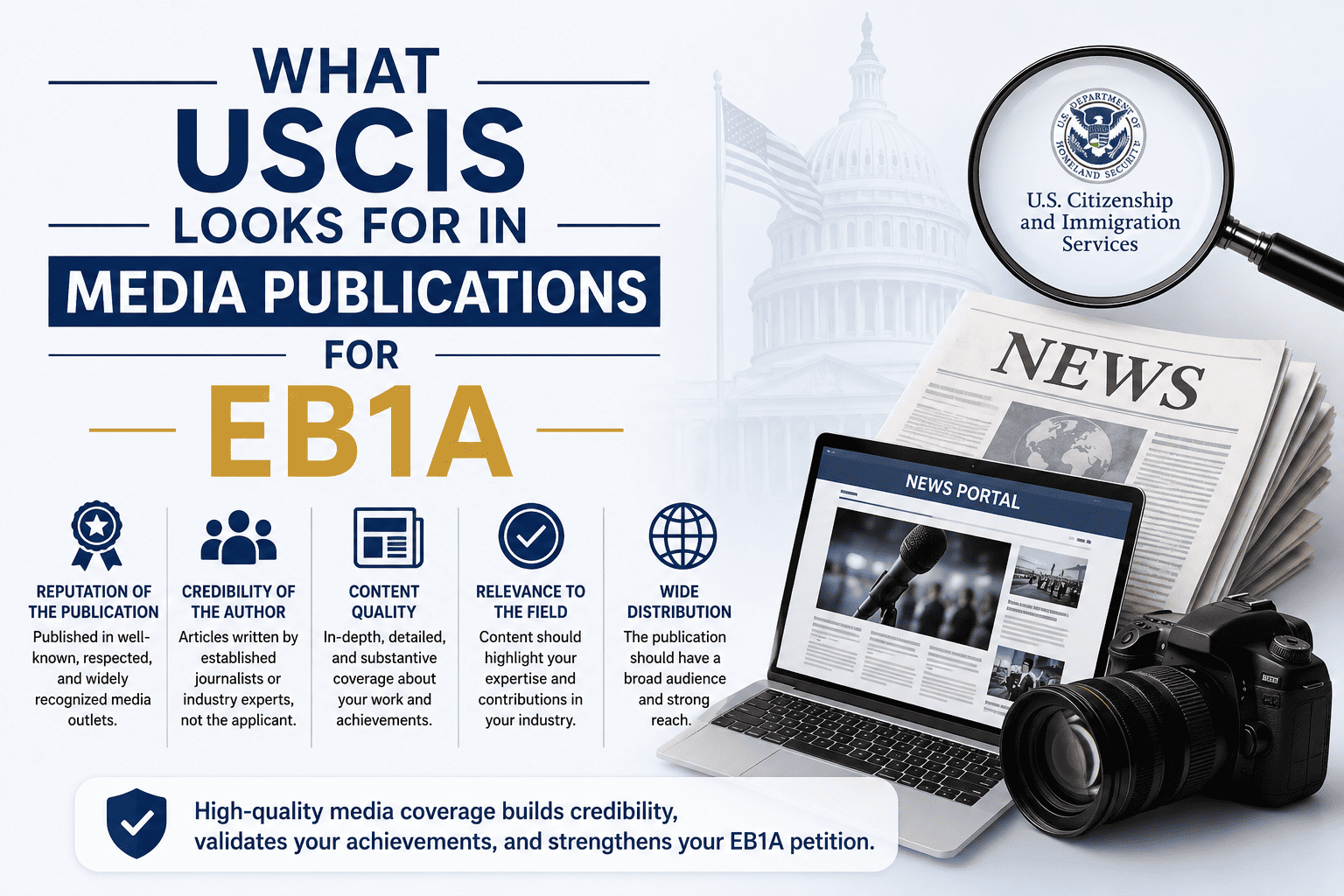
Most EB-1A applicants who fail the published material criterion do not fail because they had no press coverage. They fail because they did not understand the specific questions USCIS is asking when an adjudicator reviews what they submitted.
USCIS is not reading your articles to be impressed. Officers run each piece of evidence through a structured evaluation process designed to answer a narrow legal question: does this published material prove that an independent, recognized source has acknowledged this person’s professional work as significant? Every other consideration — the length of the article, the visual reputation of the outlet, the number of quotes from the applicant — is secondary to that question.
This guide walks through the exact evaluation framework USCIS applies to media publications submitted as EB-1A evidence. Understanding this framework changes how you select, document, and present press coverage in your petition.
The Legal Foundation: What the Regulation Actually Says
Before examining how USCIS evaluates media, the regulatory language is worth reading precisely. Under 8 C.F.R. § 204.5(h)(3)(iii), one of the ten EB-1A evidentiary criteria is satisfied by:
“Evidence of published material about the alien in professional or major trade publications or other major media relating to the alien’s work in the field for which classification is sought. Such evidence must include the title, date, and author of the material, and any necessary translation.”
Four elements are embedded in this single sentence. The material must be about the applicant. It must appear in professional or major trade publications or other major media. It must relate to the applicant’s work in the field of extraordinary ability. And it must be documentable with a title, date, and author.
Each of these four elements is separately evaluated. Satisfying three while falling short on one is not a partial success. It is a failed submission. USCIS will not give partial credit for coverage that is about you but appeared in a non-qualifying outlet, or for coverage in a qualifying outlet that is about your company rather than your professional contributions.
The Kazarian v. USCIS decision (2010), which established the current two-step adjudication framework for EB-1 petitions, further clarified that meeting criteria at Step 1 does not guarantee approval. Step 2 requires USCIS to evaluate the totality of evidence under a “preponderance of the evidence” standard and confirm that the petitioner is genuinely among the small percentage at the top of their field with sustained national or international acclaim. Media coverage that technically clears Step 1 but lacks depth, credibility, or field relevance often fails to contribute meaningfully to the Step 2 determination.
The Two-Part USCIS Test for Media Evidence
What is the USCIS Two-Part Test for Published Material?
USCIS evaluates every piece of media evidence submitted under the published material criterion using a mandatory two-part test. Part one asks whether the published material is genuinely about the applicant and their work in the field of extraordinary ability. Part two asks whether the outlet qualifies as a professional publication, major trade publication, or major media. Both parts must be satisfied independently. Strong performance on one cannot compensate for failure on the other.
This structure matters practically because most media submission errors fall cleanly into one of two categories. The first category is articles in recognized outlets that fail because they focus on a company, project, or event rather than on the applicant’s individual expertise and contributions. The second is articles that discuss the applicant substantively but appear in outlets that do not qualify as professional, major trade, or major media.
Understanding which part of the test your coverage fails is the starting point for correcting it.
Part One: Is the Article Genuinely About You?
The “About the Alien” Standard
The first question USCIS asks is whether the submitted material is about the applicant specifically. USCIS guidance is explicit that the published material should be about the applicant’s work in their field of expertise, not about their employer, not about an organization they are affiliated with, and not about an event they attended or participated in peripherally.
This creates several common failure patterns that applicants encounter repeatedly.
Company-focused coverage. Many professionals in business, technology, and finance receive coverage in recognized outlets when their company achieves a milestone, closes a funding round, launches a product, or announces a strategic initiative. These articles are often published in major media. The company name appears in the headline. The applicant is quoted multiple times. USCIS will still not count it, because the article is about the company, not about the applicant as an individual professional. The spotlight must be on the applicant’s expertise as the central subject of the article.
Passing mentions and quoted sources. An article that includes a quote from the applicant as one of several industry voices commenting on a trend does not satisfy the standard. Even if the quotes are extensive and the applicant appears multiple times, coverage that positions them as a source rather than a subject carries limited evidentiary weight. The article should identify the applicant’s contributions, expertise, and significance as its primary purpose, not use them as supporting commentary for a broader narrative.
Event coverage. Articles that report on a conference, summit, awards ceremony, or industry event and mention the applicant as a speaker, attendee, or award recipient fail the first test unless the article pivots to a substantive discussion of the applicant’s individual professional work. A sentence confirming attendance at an event does not satisfy the standard.
Team and collaborative work. Coverage of a team project, co-authored research, or collaborative initiative can qualify, but only if the article establishes the applicant’s specific and significant role in that work. USCIS does not require the applicant to be the sole subject, but the article must meaningfully address the applicant’s individual contributions and clearly attribute them. Generic team coverage without individual attribution does not clear the first test.
The framing adjudicators use is whether the applicant is the primary subject of the article rather than a contributor to someone else’s story. Profile formats, in-depth interview formats, and feature formats where the applicant’s career, expertise, and impact are the organizing principle of the story most reliably satisfy this requirement.
Part Two: Does the Outlet Qualify?
USCIS does not provide a fixed list of qualifying outlets. The regulation uses three category labels: professional publications, major trade publications, and major media. Each is evaluated through a different set of factors, and USCIS officers are expected to assess each outlet against objective evidence of its standing rather than their personal familiarity with it.
This means that submitting coverage from a major outlet without documenting that outlet’s standing is an error even when the outlet is genuinely major. USCIS officers reviewing EB-1A petitions handle cases across hundreds of industries and dozens of countries. An officer may not independently know that a publication is the dominant trade journal in cardiovascular surgery, the most-read financial daily in India, or the most cited security research outlet in cybersecurity. The petition must establish this context. Assuming the officer already knows is a documentation failure that produces preventable RFEs.
What is “Major Media”?
Major media refers to mainstream news outlets, national newspapers, prominent general-interest publications, and established digital news platforms with substantial national or international reach, independent editorial standards, and public recognition as authoritative news sources. USCIS evaluates major media status through circulation figures, unique monthly visitor data, geographic reach, and the publication’s reputation as a news source within its market.
Publications such as The New York Times, The Wall Street Journal, Forbes, the Financial Times, BBC News, and equivalent national or international titles are generally accepted as major media without requiring additional documentation of their standing. For outlets that are major media in specific countries or regions but may be unfamiliar to a USCIS officer, the petition must include objective evidence of the publication’s reach: monthly traffic data from independent analytics platforms, Audit Bureau of Circulations print figures, or equivalent third-party verified data.
For print major media, circulation figures above 100,000 copies provide a useful working benchmark, though context matters. A national newspaper with daily print circulation of 270,000 presents a clear major media case. A regional newspaper at the same circulation figure may need more documentation to establish national reach.
For digital-first or digital-only outlets, traffic volume is the primary metric. A publication drawing tens of millions of monthly unique visitors presents a strong major media case. For publications with one to ten million monthly visitors, the petition should document the outlet’s editorial authority, industry recognition, and standing as a credible news source rather than a content aggregation platform.
What is a “Professional Publication”?
Professional publications are outlets targeting practitioners, researchers, or experts in a specific professional field. These include peer-reviewed academic and scientific journals, professional association publications, clinical journals in healthcare, technical publications in engineering and computer science, and recognized research outlets across any discipline.
The key factors USCIS evaluates are the intended readership (practitioners and experts rather than the general public), the publication’s editorial process (peer review, expert editorial board, or equivalent independent expert oversight), and its standing within the professional community it serves.
For scientists and researchers, coverage in Nature, Science, IEEE Spectrum, or equivalent peer-reviewed or expert-readership journals is recognized as professional publication coverage without requiring additional documentation. For professionals in applied fields, coverage in respected trade and industry journals that practitioners read and cite carries equivalent weight.
What is a “Major Trade Publication”?
Major trade publications cover a specific industry or sector and are recognized by practitioners in that industry as authoritative sources. These differ from professional journals in that they cover industry news, business developments, and applied topics rather than academic research content. They differ from major media in that they target an industry audience rather than the general public.
Examples include Healthcare IT News for health technology, TechCrunch and Wired for the technology sector, Harvard Business Review for business and management, and equivalent titles across finance, real estate, legal, and other professional sectors.
A publication does not need the circulation of a national newspaper to qualify as a major trade publication. A journal read by 50,000 specialists in a surgical subspecialty can carry more evidentiary weight for a surgical innovator than a general-interest publication with 10 million readers, because the recognition comes from the precise professional community the applicant claims to lead. Documenting that community-specific authority is how trade publication evidence is most effectively presented.
The Five Factors USCIS Uses to Evaluate Every Media Submission
Within the two-part test, USCIS adjudicators assess media evidence through five specific factors. Understanding each allows applicants to evaluate their existing coverage and identify documentation gaps before filing.
Factor 1: Circulation and Audience Reach
USCIS requires applicants to identify the circulation, either online or in print, and the intended audience of each publication submitted. This is not optional. It is an explicit regulatory requirement stated in USCIS policy guidance under the published material criterion.
For each article submitted, the petition should include the publication’s monthly unique visitor count for digital outlets, average print circulation figures from an independent auditing body, or viewership figures from independent measurement services for broadcast coverage.
USCIS officers are trained to treat circulation statistics published by the outlet itself as less reliable. Self-reported data from a publication’s own advertising media kit carries less weight than figures from independent third-party auditing bodies. When documenting an outlet’s reach, prioritize independent verification: IFABC data, ABC India reports, Audit Bureau of Circulations figures, and Similarweb or equivalent verified digital traffic reports carry more credibility in a petition than a publication’s own stated numbers. A secondary documentation strategy is to cite descriptions of the outlet published by other media or organizations, since third-party references to a publication’s standing carry independent credibility.
Factor 2: Editorial Independence and Authorship
USCIS evaluates whether the coverage reflects the independent editorial judgment of a journalist or editorial body rather than the controlled output of the applicant or their representatives. Articles written by named staff journalists who independently researched and reported the story receive the highest evidentiary weight.
Author documentation matters beyond the byline. For each submission, include evidence that the named author is a journalist or contributor with professional standing at the outlet. An author’s other published articles, their staff profile page at the publication, or their verifiable journalism credentials establish this independently.
Coverage in outlets known to sell bylined features to contributors who pay for placement cannot be rehabilitated by pointing to a named author. The commercial relationship between the applicant and the outlet is the disqualifying factor, not the presence or absence of a byline.
Factor 3: Substantive Discussion of the Applicant’s Work
USCIS applies the “substantial discussion” standard: the article must do more than mention the applicant’s name or include them as a quoted source. The coverage must substantively discuss the applicant’s professional contributions, expertise, or impact in a way that conveys why their work is significant to their field.
Articles that satisfy the substantial discussion standard typically explain what the applicant has accomplished, analyze why it matters to the field or to a broader audience, and provide enough professional context that a reader unfamiliar with the applicant would understand the significance of the contribution being described. Profile formats, in-depth interviews with substantial professional context, and reported pieces that examine the applicant’s methodology and impact most reliably produce this level of discussion.
USCIS officers are also trained to distinguish between an article substantially about the applicant’s work and one that merely uses the applicant as an illustrative example within a larger story. If the article would be 95 percent identical without the applicant’s involvement, the coverage is not substantially about the applicant.
Factor 4: Relevance to the Claimed Field of Extraordinary Ability
The article must relate to the applicant’s work in the specific field for which they are claiming extraordinary ability. Coverage in unrelated areas does not count toward this criterion. A technology entrepreneur claiming extraordinary ability in software architecture who is profiled in a business publication about their philanthropic work has produced coverage that USCIS will disregard.
In 2026, USCIS adjudicators are increasingly looking for coverage that demonstrates the applicant’s standing within their specific professional community, not just general business or professional press. A software engineer may strengthen their petition more with a substantive feature in IEEE Spectrum or MIT Technology Review than with equivalent coverage in a general business publication, because the field-specific outlet signals that the applicant’s professional peers, not just a broad audience, consider the work significant.
Field relevance and outlet prestige are not in conflict. The strongest media evidence combines both: a recognized major or trade publication that is also field-relevant, where a journalist covering the applicant’s specific area has chosen to feature the applicant’s work substantively.
Factor 5: Independence From the Applicant and Their Employer
Coverage originating from the applicant’s own organization, paid for by the applicant or their employer, or produced under conditions where the applicant exercised editorial control over the final content does not satisfy the independence requirement.
USCIS is explicit that marketing materials created to promote the applicant’s products or services do not qualify. Materials published by an employer about their own employee are treated as self-promotional. Press releases and their verbatim republication on aggregator websites are treated as promotional distribution rather than independent coverage.
The independence requirement is why media evidence carries evidentiary weight that no other petition element can replicate. When an independent journalist at a recognized publication chooses to write about an applicant’s work, they are providing third-party validation that cannot be manufactured. That validation is the specific thing USCIS is looking for when it evaluates media publications.
Documentation: What Must Accompany Every Media Submission
Meeting the two-part test and satisfying the five evaluation factors is necessary but not sufficient. USCIS requires specific documentation to accompany each media submission, and missing documentation creates RFE risk even when the underlying coverage is genuinely strong.
For every article submitted, the petition should include a complete copy showing the article title, publication name, date of publication, and author name. For digital articles, include a full-page screenshot or PDF as it appeared online, with the URL visible, the publication date clearly shown, and the author byline present. For print articles, include a copy of the physical page showing the masthead or publication header alongside the article.
Beyond the article itself, each submission should be accompanied by a documentation exhibit establishing the publication’s standing. For outlets USCIS is unlikely to independently recognize, this exhibit should include third-party traffic data or circulation figures, a brief description of the publication’s editorial history and scope, evidence of the outlet’s recognition as a credible source within its field or market, and if applicable, print circulation figures from an independent audit body.
For articles in languages other than English, certified translations are required. The translation must include a statement from the translator confirming competence in both languages and accuracy of the translation.
Annotation strengthens the submission significantly. Rather than submitting a stack of articles and expecting an adjudicator to locate your name, identify the field relevance, and verify the outlet’s standing, structure each exhibit so the petition brief specifies where in the article the applicant appears as the subject, what professional contributions are discussed, and what data establishes the outlet’s major media or professional publication status.
Errors That Most Commonly Produce RFEs on This Criterion
Based on documented RFE patterns and immigration attorney guidance through 2025 and 2026, the following errors account for the largest proportion of RFEs and denials on the published material criterion.
Submitting company-focused coverage. This is the single most common error for business professionals, executives, and entrepreneurs. Before including any article, confirm that the article’s primary subject is the applicant as an individual professional, not the company, product, or initiative they are associated with.
No circulation documentation for non-obvious outlets. Any outlet that is not a widely recognized US publication requires third-party circulation or traffic documentation. This includes major publications from other countries, industry trade publications with strong credibility in their sector but limited general-public recognition, and digital-native outlets without print circulation history.
Including paid content without identifying it as paid. Applicants who worked with PR agencies sometimes receive what appeared to be organic coverage but was in fact a paid placement. Review all media coverage for disclaimer language and confirm with your PR representative whether any placement fees were involved before including any article in your petition.
Quoting appearances mistaken for profile features. An article that quotes the applicant five times across 1,500 words is not the same as a 1,500-word profile of the applicant. Assess what proportion of the article is primarily about the applicant and their contributions. If that proportion is below roughly half, the coverage carries weaker substantial discussion evidence and should be supplemented with stronger material.
Field mismatch between claimed extraordinary ability and article topic. Every article submitted should connect clearly to the specific field named in the petition. Coverage in adjacent or unrelated areas does not strengthen the published material criterion and can introduce inconsistency that weakens the final merits narrative.
Missing author attribution without documentation explaining its absence. Articles without a clearly identifiable author create documentation risk. Either verify that the publication routinely uses institutional bylines as a standard editorial practice and document that practice explicitly, or target coverage from outlets where individual journalist bylines are standard.
How Media Evidence Functions in the Final Merits Determination
The published material criterion is one of ten. Clearing it at Step 1 means USCIS has confirmed that at least one of the three required criteria has been satisfied. But the adjudication does not end there.
At Step 2, the final merits determination, USCIS reviews the totality of all evidence and assesses whether the petitioner has demonstrated sustained national or international acclaim at the level required to qualify as among the small percentage at the top of the field. The EB-1A approval rate dropped to 53.4% in Q4 2025, down from 66.9% for the full fiscal year, with former USCIS officers attributing the decline primarily to stricter application of the final merits review rather than formal policy changes. Officers in 2026 are exercising broader discretion to deny cases at Step 2 even when Step 1 criteria are technically met.
Strong organic media coverage in recognized publications, when it is genuinely substantive and field-relevant, provides the kind of independent third-party validation that USCIS finds most credible at the final merits stage. An adjudicator who sees a petitioner covered by multiple independent journalists in recognized outlets over a period of years is seeing objective evidence that independent observers with no stake in the petition’s outcome have assessed the petitioner’s work as significant. That pattern of independent recognition is what the EB-1A standard was designed to capture.
This is why media evidence that technically satisfies the published material criterion but lacks depth, credibility, or independence may clear Step 1 while weakening Step 2. Shallow coverage in a large outlet demonstrates access to media, not recognition of extraordinary ability. Deep, substantive coverage in a recognized publication in the applicant’s field demonstrates exactly the kind of third-party validation the final merits standard is designed to evaluate.
The practical implication is straightforward. Build media evidence around quality, field relevance, independent authorship, and thorough documentation. A petition with three deeply evidenced organic features in recognized publications, each properly annotated with outlet standing data, is stronger than a petition with ten superficial placements from a mix of paid and organic sources. USCIS in 2026 is prioritizing substance over volume, and media evidence that reflects sustained independent recognition over time is the most persuasive form that criterion can take.
Brandhexa helps professionals and executives develop media profiles built to USCIS standards, securing organic editorial coverage in recognized publications with the documentation each submission requires. For media strategy consultations, contact the Brandhexa editorial team.
Comments are closed