
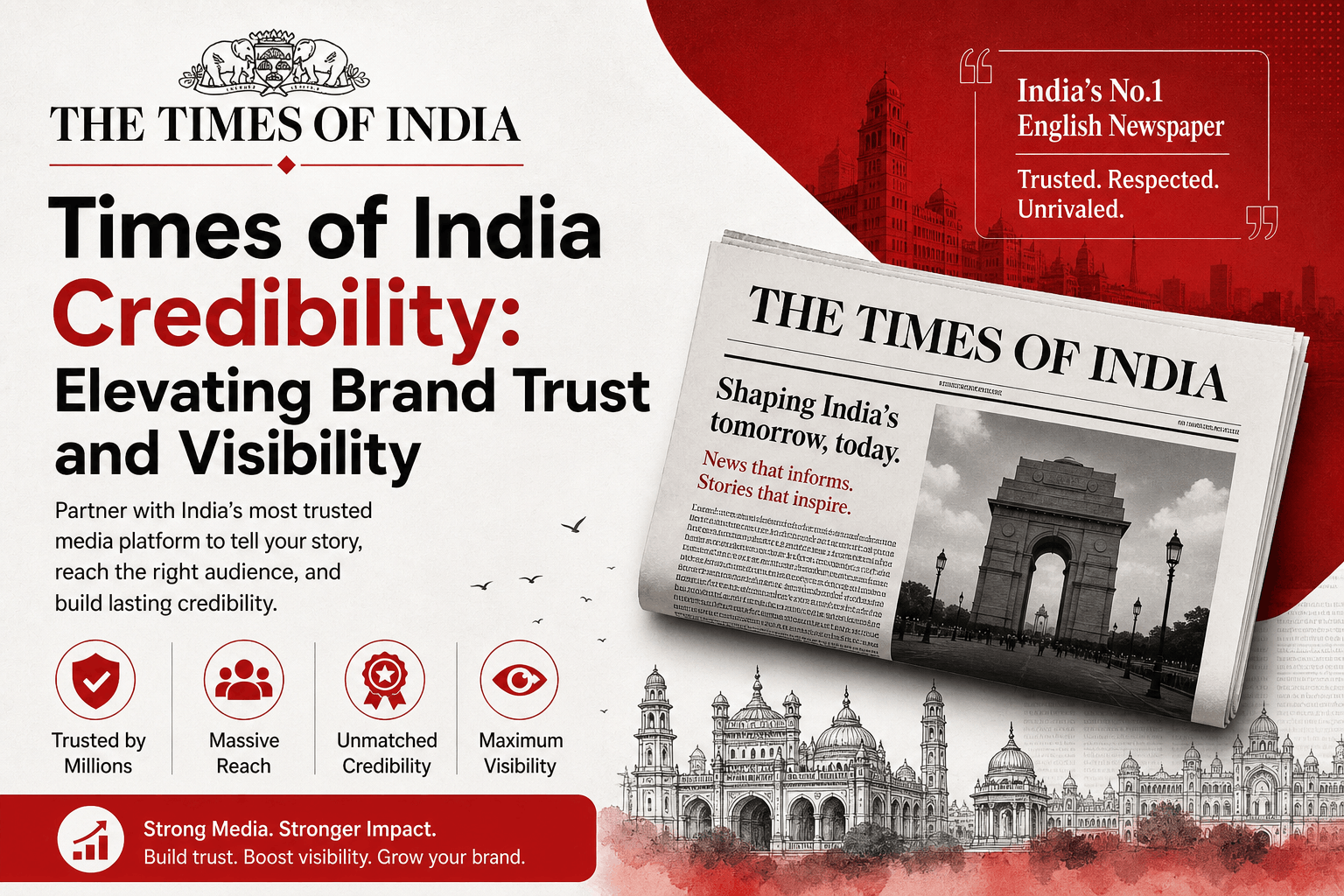
There are very few media platforms in India where a single article can genuinely shift how an entire audience perceives you. The Times of India is one of them.
This is not about vanity press. It is about what institutional credibility actually does for a brand, a professional, or a business in practical terms. A feature in TOI changes how investors evaluate you. It changes what comes up first when a customer searches your name. It changes how industry peers and media outlets treat future outreach from your team. It creates a permanent, verifiable record of your story on one of the most authoritative news domains in the world.
This article examines why Times of India credibility carries the weight it does, what the platform’s authority means in measurable terms, and how individuals and businesses can use a TOI feature to build lasting personal and professional reputation.
What the Times of India Actually Represents
What is the Times of India?
The Times of India (TOI) is India’s oldest English-language newspaper and the largest-selling English-language daily newspaper in the world. First published on November 3, 1838 as The Bombay Times and Journal of Commerce, it is owned by Bennett, Coleman and Co. Ltd. (BCCL), part of The Times Group controlled by the Sahu Jain family. Today, TOI has over 139 editions and reaches 1,200 towns across India. Its digital platform, timesofindia.com, extends its reach to a global audience.
TOI carries a print circulation of 2.8 million copies, a print readership of 7.643 million, and a digital footprint that draws hundreds of millions of visits every year. In 1991, the BBC ranked TOI among the world’s six best newspapers. Lord Curzon, Viceroy of India in the early 20th century, called it “the leading paper in Asia.” In the Brand Trust Report India 2019, TOI was rated the most trusted English newspaper in India.
That is the institution whose name is attached to any article published on its platform. When you are featured in the Times of India, that 187-year legacy of editorial history is the context in which your story is presented.
The Specific Credibility Signals TOI Carries
Credibility in media is not a vague concept. It is built through measurable attributes: editorial independence, fact-checking standards, institutional age, reader trust, and the quality of audience attention. TOI performs at the top end of every one of these dimensions for India’s English-language media landscape.
After Indian independence, TOI’s insistence on accuracy, its avoidance of sensationalism, its serious tone, and its coverage of international news enhanced its prestige across India, where it became known as an intellectual newspaper. That journalistic culture persists in how the platform evaluates content today, including brand-related submissions.
For readers, this matters because TOI content carries an editorial stamp of approval. For brands, this matters because that stamp transfers, in part, to what is published there. Being featured in TOI communicates that an editorial process found your story credible enough to put in front of millions of readers. That is a fundamentally different signal from anything a brand can say about itself through its own channels.
A survey by the Reuters Institute for the Study of Journalism rated TOI the most trusted news brand among English-speaking online news users in India. Reader trust is the engine that makes media credibility work as a branding tool. Without it, coverage is just noise. With it, coverage becomes proof.
TOI’s Authority in Numbers
Understanding the platform’s digital authority gives you a clear picture of what a TOI feature actually delivers.
The Times of India’s digital platform carries a domain authority of 94 and a domain rating of 91, placing it among the most authoritative news websites anywhere in the world. For context, most company websites sit between DA 20 and DA 50. The difference between a backlink from a DA 50 site and a DA 94 site is not incremental. It is categorical.
TOI’s digital platform recorded over 231 million monthly visitors, making it one of the highest-traffic English-language news sites in Asia. Organic search is the dominant traffic source, which means the people reading TOI content found it through genuine search intent rather than algorithmic amplification. That translates to an engaged, actively curious readership, exactly the kind of audience whose attention carries conversion and trust value.
The platform has over 71 million backlinks, accumulated over decades of editorial publishing. Each new article published on timesofindia.com is indexed by Google immediately, benefits from the domain’s accumulated authority, and can rank for competitive search terms in ways that articles on lower-authority sites simply cannot.
These are not abstract figures for SEO specialists. They are the measurable foundation of why a TOI placement creates long-term value for the brands and people featured there.
How TOI Credibility Translates to Reputation for Individuals
The professional landscape in India operates heavily on trust signals. When decision-makers, investors, and institutional buyers evaluate a person, they look beyond a CV or a LinkedIn profile. They search for third-party evidence that someone has been recognised by sources that are not controlled by the individual themselves.
A Times of India feature is one of the strongest third-party credibility signals available in India. Here is why it works at every stage of a professional’s journey.
For early-career professionals and founders: A TOI article in your early years creates a searchable record that establishes your presence and perspective before most of your peers have any media footprint at all. When recruiters, potential clients, or accelerator program judges search your name, they find a feature on India’s most-read English newspaper rather than nothing or a social media profile.
For established executives and experts: At a more advanced stage, a TOI feature reinforces authority that you have already built and extends it to new audiences. It introduces your perspective to the platform’s hundreds of millions of readers who have no existing relationship with you. It strengthens the first-page Google search result for your name with an authoritative citation that is unlikely to disappear.
For professionals building international profiles: A verifiable feature on TOI specifically addresses the requirements of audiences outside India who need documented evidence of your standing. TOI is internationally recognised as India’s newspaper of record. A feature there carries weight in boardrooms, conference speaker selection processes, and institutional evaluations in ways that niche publications or self-published content cannot.
A printed or digital article in a major newspaper is not just a piece of information. It is a statement backed by the publication’s own reputation. That backing is what makes the difference between self-promotion and credibility.
How TOI Credibility Builds Business Reputation
For businesses, the value of a Times of India feature operates on several levels simultaneously.
Customer trust: Consumers in India place significant weight on media recognition when evaluating unfamiliar brands. A feature in TOI removes the friction of uncertainty. It communicates that an independent, credible editorial institution has reviewed your story and found it worth sharing. This has a measurable effect on purchasing behaviour, particularly for high-consideration products and services where trust is the primary barrier.
Investor and partner confidence: When a business is fundraising, entering a new market, or seeking strategic partnerships, the quality of its media footprint influences how potential partners evaluate it. A TOI feature in a business’s press kit or website “As Seen In” section signals institutional seriousness in a way that social media followers and self-published testimonials cannot.
Talent acquisition: The quality of candidates a business attracts is shaped in part by how the company is perceived publicly. A business with credible national media coverage attracts higher-calibre candidates who see it as a legitimate, serious employer. TOI coverage contributes directly to that perception.
Crisis resilience: Businesses with established credibility in respected media have more resources to draw on when challenges arise. A portfolio of credible coverage provides counter-narrative material, demonstrates historical legitimacy, and gives the business a platform to communicate its response through channels that readers trust.
A feature in TOI does not just spread awareness. It positions the brand as credible, substantive, and endorsed by established media. That positioning compounds over time.
The Long-Term SEO Value of a TOI Feature
The SEO dimension of a Times of India feature is consistently underestimated by brands that think about media coverage only in terms of immediate readership.
A backlink from timesofindia.com, a DA 94 domain, is among the most valuable digital assets an SEO campaign can acquire. Websites with referral traffic from high domain authority sites convert at significantly higher rates than traffic from low authority sources. A single genuine TOI backlink contributes to your domain’s authority in ways that dozens of mid-tier guest posts cannot replicate.
Beyond the backlink, the article itself ranks independently in Google. An article about your brand or expertise published on a DA 94 platform will often rank above content about you on lower-authority sites, ensuring that the first thing people see when they search your name is the version of your story you invested in telling correctly.
This ranking effect is permanent. Unlike paid search, which stops delivering the moment you stop paying, or social media content, which disappears from active feeds within days, a well-placed TOI article continues to surface in relevant searches months and years after publication. The value compounds rather than depreciates.
Articles on timesofindia.com are indexed in Google News, providing an additional exposure channel for branded and niche keyword searches. Readers who discover the article through news search are typically in a higher-intent information-gathering mode than passive social media browsers, making their engagement with your brand more commercially significant.
What Content Earns Its Place in TOI
Not every story is suitable for the Times of India, and understanding what content gets accepted is essential for anyone approaching the platform with a brand narrative.
TOI’s editorial culture values accuracy, public relevance, and informational value. Content that reads like a brochure, makes unverified superlatives, or exists purely to promote a product gets rejected or pushed back. The platform’s nearly two centuries of editorial history inform a culture that takes content standards seriously.
Content that performs well on TOI includes:
Thought leadership and opinion pieces. Articles where founders, executives, or domain experts offer genuine perspective on industry developments, policy questions, or social issues. The key is that the author’s credentials and the quality of the argument justify the platform’s willingness to share the perspective with millions of readers.
Brand and company milestones with genuine news value. Funding announcements, market expansions, significant product launches, research findings, or industry firsts. The news hook must be real. TOI readers are sophisticated and editors are experienced at distinguishing genuine news from manufactured events.
Expert commentary on current developments. Articles that connect a company’s expertise to something currently happening in the news cycle. A healthcare company commenting on a public health development, a fintech firm offering analysis of a regulatory change, or an education company responding to an evolving landscape. This format works because it positions the author as a relevant voice at the moment when readers are actively seeking perspectives.
Interview and profile features. Stories about the person behind a company or initiative. These work when the individual has a journey, a perspective, or a background that offers something genuinely interesting to a general English-language news audience.
In every case, the content must be written in journalistic language rather than marketing language. That distinction is not semantic. It reflects the difference between content that serves the reader and content that serves only the brand.
TOI Features for Visa and Immigration Documentation
One specific use of a Times of India feature deserves attention because it is directly tied to the platform’s institutional credibility in an international context.
Professionals applying for visa categories that require evidence of extraordinary ability or recognised standing use media coverage as a central component of their application portfolio. The visa categories most commonly served by this evidence include the O-1 Extraordinary Ability visa, EB-1A, EB-2 NIW, UK Global Talent Visa, and equivalent programs in Canada and Australia.
These applications ask applicants to demonstrate that credible, independent third parties have recognised their standing in their field. A feature in the Times of India, the largest-selling English-language newspaper in the world with a domain authority of 94, is one of the most powerful pieces of media evidence available for this purpose.
The logic immigration authorities apply is straightforward. If a publication with over 231 million monthly readers and 187 years of editorial history found your story credible enough to publish, that is independent third-party recognition of a meaningful kind. It carries more weight than coverage in lower-authority outlets and substantially more weight than self-published content.
Preparing content for this purpose requires understanding both the editorial requirements of the publication and the evidentiary standards of the visa category. Specialist agencies like BrandHexa bridge both requirements, preparing TOI-standard editorial content that also functions as documented evidence of professional recognition.
BrandHexa: A Dedicated Partner for TOI Publication
For brands and professionals who want to invest in TOI credibility without navigating the editorial process independently, working with a specialist makes the process significantly more reliable.
BrandHexa is a digital PR agency that has built direct relationships with editorial teams at the Times of India and other premium Indian publications. Their TOI placement service covers the full process from content strategy and article creation through editorial review and confirmed publication, with delivery of the live URL as proof.
Their published metrics for the TOI service reflect the platform’s actual authority: DA 94, DR 91, and over 231 million monthly visitors. Pricing is transparent and their portfolio of placed articles is available for review through live, indexed URLs. Standard turnaround runs 10 to 15 working days.
BrandHexa also serves professionals building media portfolios for visa applications, a specific use case that requires content to meet both TOI’s editorial standards and immigration documentation requirements simultaneously. This dual-purpose expertise is not widely available among general PR agencies.
For brands building credibility in India’s competitive market, and for professionals who need verified national media recognition, BrandHexa offers a structured, outcome-focused path to TOI publication.
The Difference Between TOI and Other Indian Media
A natural question when considering TOI is how it compares to other credible Indian publications. The honest answer is that several Indian platforms carry strong authority, but they do not all carry the same combination of institutional age, editorial reputation, domain authority, and global recognition.
Hindustan Times, India’s second-most-read English daily, carries a domain authority above 90 and has its own strong history and readership. The Hindu carries deep credibility among academic and policy audiences. Economic Times leads in business and financial readership. Each serves a distinct audience with distinct strengths.
TOI’s specific advantage is the combination of its scale, its status as the oldest English-language newspaper in India, its position as the world’s largest-selling English-language daily, and its DA 94 digital authority. For brands that need credibility across the broadest possible English-language Indian audience, and for professionals whose claims of national recognition need to withstand scrutiny in international contexts, TOI sits at the top of the hierarchy.
Frequently Asked Questions
Q1. Why is Times of India considered India’s most credible English-language newspaper?
TOI has been publishing since 1838, making it the oldest English-language newspaper in India. It holds the largest print circulation of any English-language daily in the world at 2.8 million copies. In 1991, the BBC ranked it among the world’s six best newspapers, and in 2019 it was rated the most trusted English newspaper in India by the Brand Trust Report. Its digital platform carries a domain authority of 94, one of the highest of any news site globally.
Q2. How does a TOI feature strengthen a personal brand?
A Times of India feature creates permanent, searchable third-party validation for your professional standing. It establishes a record that surfaces when investors, employers, or clients search your name. It signals that an independent editorial institution with hundreds of millions of readers found your story worth publishing, which is categorically different from self-published content.
Q3. What is the SEO value of being published on Times of India?
A backlink from timesofindia.com, a DA 94 domain, carries significant weight in Google’s authority calculations and improves your website’s domain authority and search rankings over time. The published article itself ranks independently in Google and Google News, delivering continued visibility long after the publication date.
Q4. Can small businesses and startups benefit from TOI features?
Yes. For startups and small businesses, TOI coverage removes the credibility friction that comes with being unfamiliar. It communicates to investors, potential partners, and customers that an independent institution has verified your story. It is particularly valuable when entering competitive markets or approaching institutional buyers who require validated credibility before engaging.
Q5. What content formats does TOI accept for brand features?
TOI accepts thought leadership articles, business milestone stories with genuine news value, expert commentary on current developments, interview and profile features, and opinion pieces from credentialed authors. All content must be written in informative, journalistic language rather than marketing or promotional copy.
Q6. Is a TOI feature permanent? Yes. Articles published on timesofindia.com remain indexed indefinitely. They continue to surface in relevant Google searches long after publication, compounding in value over time rather than depreciating like paid advertising.
Q7. Can a Times of India feature help with visa applications?
Yes. A verifiable TOI feature is used as evidence of recognised standing in immigration applications for O-1, EB-1A, EB-2 NIW, UK Global Talent, and similar visa categories. TOI’s global recognition as the world’s largest-selling English-language daily gives this evidence particular weight in international documentation contexts.
Q8. How do I get published in the Times of India?
There are three main routes: direct editorial pitching to TOI journalists, which is free but competitive with no guaranteed outcome; paid brand posts through TOI’s brand content channel; and organic editorial placements arranged through specialist PR agencies with established editorial relationships at TOI. Organic placements through a partner like BrandHexa start from Rs 60,000 and include the full process from content creation through to confirmed publication.
Comments are closed